
1. Introduction: The Structural Transformation of the Fourth Estate
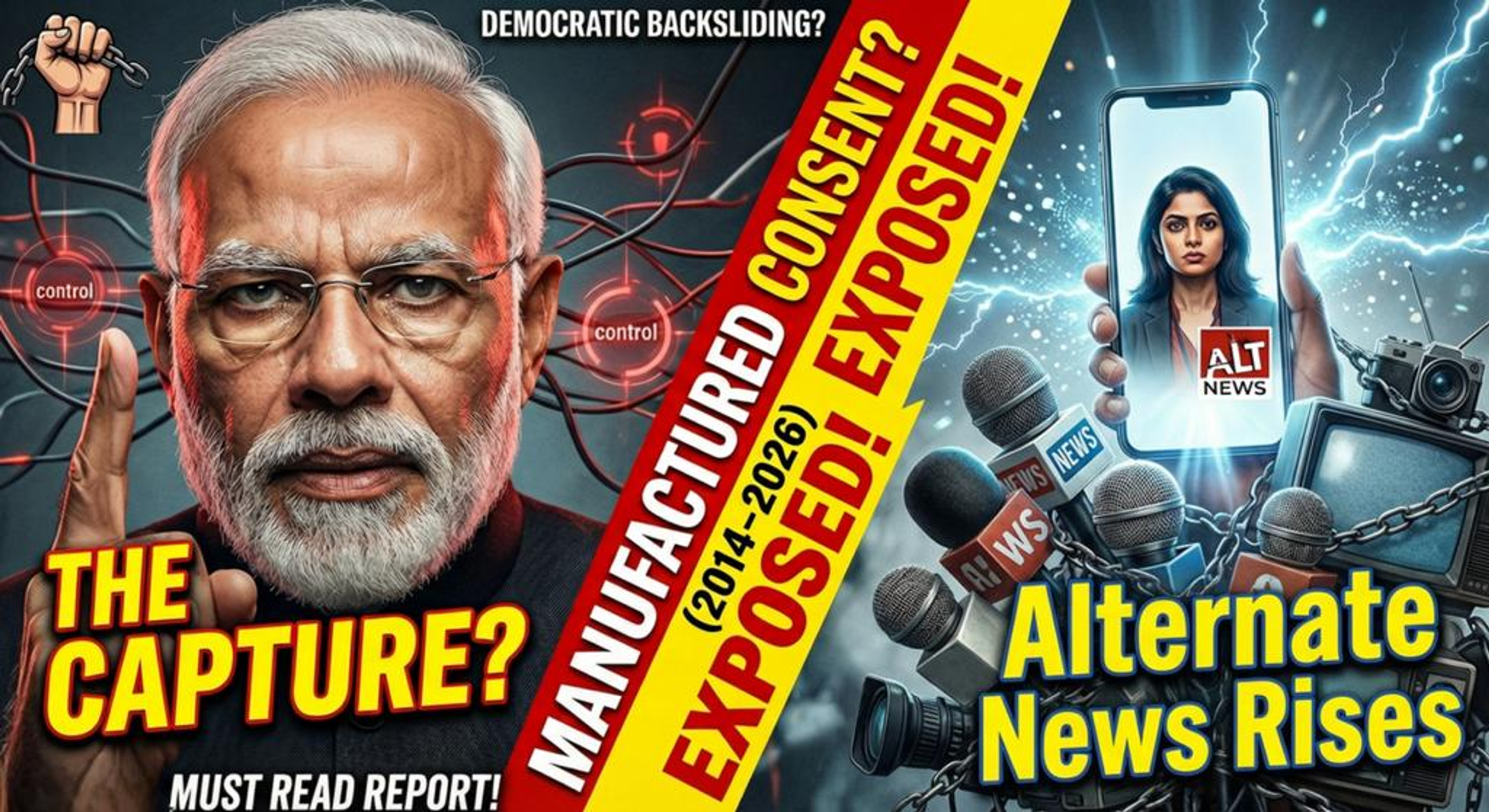
The foundational premise of a functioning democracy relies heavily upon the existence of an independent, adversarial press capable of holding the executive branch accountable, ensuring administrative transparency, and disseminating empirical truths to the electorate. However, a comprehensive longitudinal analysis of the Indian media landscape from 2014 to 2026 reveals a profound and systemic structural transformation. Following the electoral ascendancy of the Bharatiya Janata Party (BJP) in 2014, significant segments of India’s mainstream television and print media underwent a paradigm shift, transitioning from independent watchdogs into ideological state apparatuses.1 This phenomenon has catalyzed the colloquial, yet analytically accurate, conceptualization of “Godi Media”—a pejorative classification denoting a press that sits comfortably in the “lap” of the political establishment, actively prioritizing regime preservation over the public interest and effectively behaving as subservient entities to the Modi government.3
The systemic subversion of the Indian news media is not merely a byproduct of passive compliance or journalistic lethargy; rather, it represents a highly engineered ecosystem of mutual corporate benefit, financial coercion, and ideological alignment. The contemporary mainstream press in India routinely absolves the ruling government of accountability while actively vilifying opposition figures, dissenting citizens, and marginalized communities.6 This editorial realignment has resulted in a severe information deficit among the electorate. By deliberately obscuring macroeconomic decline, mismanaging coverage of public health and human rights crises, and amplifying pseudo-scientific and hyper-nationalistic narratives, the mainstream media has successfully manufactured a sanitized alternate reality that keeps the public entirely in the dark regarding governance failures.8 Furthermore, the media’s embrace of a right-wing majoritarian ideology has acted as an accelerant for communal violence, leading to a surge in riots and hate crimes not witnessed since the nation’s independence.10
Consequently, this profound vacuum of credible information, characterized by a press that has ostensibly sold its conscience, has necessitated the emergence of a parallel, decentralized digital ecosystem. This new vanguard—comprising independent news portals, digital-native YouTube commentators, political satirists, and social media influencers—has assumed the abandoned responsibilities of the traditional press.13 This report exhaustively analyzes the mechanisms of media capture in India, the subsequent inversion of journalistic accountability, the promotion of majoritarian superiority and pseudoscience, and the critical role of alternative digital platforms in ensuring that the truth ultimately finds its way to the light.
2. The Political Economy of Media Subservience and Democratic Backsliding
The capitulation of the Indian mainstream media is deeply intertwined with the political economy of news production, regulatory pressures, and the weaponization of state financial resources. The resulting degradation of journalistic independence is not merely anecdotal but is empirically reflected in extensive academic studies and international assessments of democratic health.
2.1 The Weaponization of Financial Levers and Corporate Capture
The central government’s control over the financial viability of media organizations serves as the primary instrument of editorial manipulation. In a media landscape heavily dependent on advertising revenue, the state has weaponized public funds to enforce narrative compliance. Empirical data illustrates the sheer scale of this financial leverage. Between the fiscal years of 2014-15 and 2017-18 alone, the government led by Prime Minister Narendra Modi spent a total of Rs 4,806 crore on publicity, averaging an unprecedented Rs 1,202 crore per year—a stark contrast to previous administrations, which averaged significantly lower expenditures.16 Overall, the BJP-led government spends approximately USD $140 million annually on publicity, with over 40% of this expenditure allocated specifically to print advertisements in newspapers.16
| Administration Period | Average Annual Publicity Expenditure (Rs Crore) | Key Observations |
| NDA (Vajpayee) | ~47 | Baseline expenditure based on available historical data from 2002-03. |
| UPA (First Term) | ~312 | Gradual increase in state communication budgets. |
| UPA (Second Term) | ~696 | Pre-2014 escalation in publicity spending. |
| NDA (Modi, 2014-2018) | 1,202 | Massive escalation; spending routinely spiked by 40% during election years.16 |
Government advertisements function as a critical financial lever that dictates editorial policy. A comprehensive study conducted by researchers at the Stimson Center, which analyzed 30 of the largest Indian newspapers and 41 television channels between 2017 and 2018, demonstrated a direct, statistical correlation between state funding and right-wing media bias.16 The study revealed that newspapers receiving higher advertisement revenue from the BJP were substantially more likely to espouse conservative ideologies, self-censor criticism of the government, and cultivate audiences with corresponding social and economic biases.16 For legacy media outlets operating in an economically precarious environment, where up to 36% of daily newspapers earn over half of their total income from the Indian government, the threat of withdrawn advertising revenue enforces strict self-censorship.16
Furthermore, the corporatization of media ownership has effectively sterilized prime-time dissent. Big media houses, reliant on the government not only as an advertiser but as the primary regulator for broadcasting licenses, operate under enormous systemic pressure.15 This corporate capture reached a zenith with the hostile acquisition of independent networks, such as NDTV, by billionaires with close personal and financial proximity to the Prime Minister, leading to the immediate resignation of veteran journalists who recognized the death of editorial independence.17 By applying the Narrative Policy Framework (NPF), researchers have demonstrated how the ruling party has utilized these state-funded and corporatized media channels to systematically recalibrate the national narrative, spreading propaganda and “alternative facts” to achieve political hegemony.2
2.2 Global Metrics of Press Freedom Decline
The material consequences of this political economy are starkly visible in India’s precipitous decline across global democratic and press freedom indices. Institutions evaluating civil liberties consistently point to the hostility faced by independent journalists, the monopolization of information streams, and the formalization of an electoral autocracy.
| Index / Organization | Assessment Year | Indian Ranking / Classification | Key Observations |
| Reporters Without Borders (RSF) | 2019 | 140 / 180 | Decline initiating prior to the pandemic, citing physical violence against journalists. |
| Reporters Without Borders (RSF) | 2023 | 161 / 180 | Classified as a “very serious” context for press freedom, noting severe censorship. |
| Reporters Without Borders (RSF) | 2024 | 159 / 180 | Highlighted media dominance by tech giants and relentless state pressure. |
| Reporters Without Borders (RSF) | 2025 | 151 / 180 | Slight quantitative rise, yet fundamental alarm raised over media monopoly and extreme economic pressures.18 |
| V-Dem Institute | 2024-2025 | 100th (Liberal Dem. Index) | Categorized formally as an “electoral autocracy” with alarming losses in freedom of expression.6 |
| Freedom House | 2025 | “Partly Free” | Cites systemic attacks on journalists, NGOs, and minority groups by state and non-state actors.20 |
While domestic, right-wing narratives often attempt to dismiss these metrics as ideologically skewed, western conspiracies or fundamentally flawed methodologies 18, the domestic realities of censorship corroborate the international consensus. The routine invocation of sedition laws against journalists, the suspension of social media accounts reporting on hate crimes, and the systemic harassment of independent reporters validate the global alarm regarding India’s democratic backsliding.4
3. The Abandonment of Accountability: Shielding the State, Interrogating the Opposition
The traditional journalistic mandate requires the press to act as an adversarial entity, holding the executive branch accountable for policy failures and administrative incompetence. In contemporary India, this paradigm has been entirely inverted. Mainstream television networks have developed a sophisticated editorial architecture designed to insulate the Prime Minister and the central government from scrutiny while aggressively interrogating opposition parties, holding them responsible for ongoing national crises despite their lack of executive power.
3.1 Quantitative Shifts in Prime-Time Discourse
Content analyses of prime-time television broadcasts provide indisputable, quantitative evidence of this accountability inversion. A 2024 tracking study conducted by independent media watchdogs analyzed 429 segments across prime-time shows hosted by prominent anchors on six major television news channels (including Republic TV, Times Now, CNN-News18, and Aaj Tak) during the run-up to the general elections.6 The objective was to ascertain whether critical public issues received prominence over divisive, pro-establishment agendas. The findings were a damning indictment of the news media’s lost conscience.
| Prime-Time Television Theme (Feb – Apr 2024) | Number of Segments | Percentage of Total Broadcast |
| Anti-Opposition Framing | 224 | 52.0% |
| Pro-Government / Praising the PM | 116 | 27.0% |
| Jobs, Education, and Public Infrastructure | 5 | ~1.1% |
| Communal / Hindu-Muslim Polarization | Remaining | Significant minority |
Data sourced from tracking 429 prime-time segments across six major TV networks.6
This partisan alignment extends shockingly to the state broadcaster, Doordarshan (DD News), which is funded by the public exchequer. An analysis of its prime-time show Do Took between July and August 2024 revealed that 59.5% of its segments were aggressively anti-opposition, 28.6% involved the dissemination of misinformation and disinformation, and 7.1% featured overt communal polarization.7 Barely 4.8% of the programming addressed public interest issues, and even those were framed specifically to critique opposition-governed states.7 This represents a gross violation of the Prasar Bharati mandate, transforming public-funded media into a partisan, sycophantic apparatus utilized against the public interest.7 By perpetually holding the opposition responsible for the nation’s contemporary challenges, the media actively keeps the public in the dark regarding the central government’s failures.
3.2 The Complicit Obscuration of Macroeconomic Realities
To protect the government’s curated developmental narrative, the mainstream media actively participates in obscuring highly unfavorable economic data. Despite India’s projection as the fifth-largest global economy, structural weaknesses such as extreme income inequality, systemic poverty, and a severe youth unemployment crisis are systematically underreported or entirely blacked out from prime-time discussions.23
The media’s silence acts as a force multiplier for the government’s data suppression tactics. When the Ministry of Statistics manipulated GDP base years (shifting the baseline from 2004-05 to 2011-12 and introducing new MCA-21 corporate filings) to artificially inflate post-2014 growth rates by an estimated 2.5 percentage points, the mainstream press largely refused to interrogate the methodology.9 Similarly, when the government suppressed politically inconvenient unemployment reports that showed joblessness at multi-decade highs, the media remained compliant.8 The consequence is an electorate kept deliberately ignorant of the country’s economic fragility. While the top 1% controls roughly 40% of the wealth and India ranks 142nd globally in per capita GDP, the media refuses to address the destruction of the informal sector, the dual impact of rising prices and decreasing incomes, or the fact that 13 Indian cities rank among the 20 most polluted in the world.9
3.3 Media Framing of National Crises: From COVID-19 to Pegasus
The news media’s abdication of duty becomes most lethal during moments of acute national crisis. During the catastrophic second wave of the COVID-19 pandemic in 2021, which saw unprecedented mortality due to severe medical oxygen shortages and collapsing hospital infrastructure, mainstream media coverage remained stubbornly focused on shielding the government from administrative blame.25 While independent portals published investigative pieces exposing the central government’s eight-month delay in tendering oxygen plants despite early warnings, mainstream networks largely ignored the catastrophic administrative failure.28
Furthermore, the media exhibited glaring, communal double standards regarding public gatherings during the pandemic. In 2020, the Islamic Tablighi Jamaat congregation was relentlessly vilified across television networks. Anchors promoted the hashtag “#CoronaJihad,” falsely projecting the irresponsible behavior of a few onto the entire Muslim community, effectively blaming them for the virus’s spread in India.29 Conversely, when the state-sponsored Kumbh Mela—a massive Hindu pilgrimage in March and April 2021 that attracted millions and became a verified, catastrophic super-spreader event for the deadly Delta variant—occurred, it was initially defended by both the press and political leadership as “clean” and “safe,” with the media remaining silent on the government’s complicity.28
This dynamic of shielding the state was perfectly mirrored during the Pegasus spyware scandal. When the international Pegasus Project revealed in 2021 and 2023 that the Indian government was likely utilizing Israeli military-grade spyware to illegally surveil opposition leaders, constitutional authorities, activists, and independent journalists, mainstream television anchors either dismissed the investigation as a Western conspiracy against India or openly defended the state’s right to surveillance under the guise of national security.33 The Supreme Court of India was ultimately forced to intervene, noting the government’s outright refusal to cooperate with technical committees, while the mainstream media largely abandoned the story to protect the Modi administration.35
4. Manufacturing Communal Polarization and Hate Speech
Perhaps the most destructive consequence of media capture post-2014 has been the mainstreaming of communal polarization. The news media has been fundamentally responsible for exacerbating religious fault lines, directly correlating with an increase in hate crimes and communal riots that many observers note had not occurred with such frequency or state complicity since independence.
4.1 The Prime-Time Spectacle of the Hindu-Muslim Binary
Television studios have institutionalized the Hindu-Muslim binary, transforming religious animosity into a highly profitable, daily prime-time spectacle.37 In a stark departure from the pluralistic underpinnings of Indian democracy, news anchors now actively legitimize Hindutva-adjacent conspiracy theories. Concepts such as “Love Jihad” (the baseless, Islamophobic assertion that Muslim men systematically seduce Hindu women for religious conversion) and “Spit Jihad” are debated as legitimate national security threats.39 By using such rhetoric in mainstream television, news anchors add a veneer of journalistic respectability to hate speech, normalizing conspiracy theories and contributing directly to the Modi government’s project of othering minority communities.39
Sociological and media analyses reveal that Islamophobia on Indian television frequently serves as a strategic distraction technique. Spikes in communal rhetoric consistently overlap with periods of acute political or economic difficulty for the government, effectively diverting public outrage away from state failures and channeling that anger toward marginalized minority groups.39
4.2 The Empirical Link Between Online Speech, Media Coverage, and Offline Violence
The correlation between mediated hate speech and offline communal riots is not merely theoretical; it is empirically verifiable. A comprehensive, peer-reviewed study published in PNAS Nexus, which analyzed 22.4 million social media posts on the platform Koo (popular among Hindu nationalists) and cross-referenced them with communal attack data from 2020 to 2022, established a direct, causal link between specific forms of online speech and offline violence.40
The study found that the proliferation of divisive, Hindu-chauvinist hashtags—particularly “Jai Shri Ram” (JSR) expressions, which carry evocative historical connotations of majoritarian triumph following the 1992 Babri Mosque demolition—is positively associated with increased physical attacks on religious minorities.40 To verify this causal link, researchers analyzed exogenous internet outages, finding that the correlation between online speech and offline attacks disappeared when the internet was shut down, proving the digital ecosystem’s role in coordinating violence.40 Crucially, the research underscores that this speech often circumvents traditional moderation because it operates via implicit signaling—culturally specific value statements that normalize anti-minority sentiment—rendering standard algorithmic fact-checking and censorship mechanisms futile.40
The magnitude of this state-aligned media complicity is catastrophic. In 2024 alone, the India Hate Lab documented 1,165 instances of hate speech delivered at in-person events, heavily amplified by digital and broadcast media.41
| Target of Documented Hate Speech Events (2024) | Number of Instances | Percentage | Notes |
| Targeting Muslims (Explicit or Combined) | 1,147 | 98.5% | Includes calls for economic boycott and Rohingya expulsion. |
| Direct Calls to Violence / Arms | 259 | 22.2% | Explicit demands for physical harm or armed mobilization. |
| Calls to Destroy Places of Worship | 274 | 23.5% | Primarily targeting historic mosques.41 |
The impunity granted to hate speech purveyors on platforms like Facebook and WhatsApp has resulted in mob lynching and orchestrated riots, most notably the 2020 Delhi riots, the Bangalore clashes, and the 2023 Nuh violence.12 Internal reports and journalistic investigations have revealed that Facebook India selectively shielded offensive posts by leaders of the ruling BJP from moderation to preserve corporate access to the government.42 Mainstream news media shares direct culpability in this normalization of majoritarian state violence; during the anti-CAA protests and the Delhi riots, state-aligned newspapers consistently portrayed peaceful, unarmed minority protestors as violent instigators, effectively providing majoritarian sanction for police brutality and mob justice.30 Furthermore, the state has weaponized the law against those attempting to expose this reality, increasingly booking Muslim journalists under criminal charges simply for documenting or tweeting about hate crimes.22
5. Media Complicity in Human Rights Violations: The Hathras Rape Case and Farmers’ Protests
The news media’s loss of responsibility is starkly illuminated by its coverage of systemic human rights violations, where it consistently aligns with the state and socially dominant groups to suppress the truth.
5.1 The Hathras Atrocity and the Patriarchal Discourse
In 2020, a young Dalit woman in Hathras, Uttar Pradesh, was brutally gang-raped and murdered by upper-caste men. The mainstream media’s coverage of the Hathras case exemplifies a profound moral bankruptcy, characterized by victim-blaming, the rationalization of sexual violence, and a shame-blame framework dictated by patriarchal and caste-based stereotypes.45
Many prominent journalists and television channels actively collaborated with the state police narrative, aggressively denying that a rape had occurred based on a delayed forensic medical report.47 They deliberately ignored the established legal and medical consensus that forensic evidence becomes virtually impossible to gather days after an assault, and that under updated Indian legal frameworks, physical corroboration is not strictly necessary to establish rape.47 Instead of questioning the local administration’s horrific decision to forcibly cremate the victim’s body in the dead of night without the family’s consent, the vernacular and mainstream media focused on the victim’s profile, utilizing suggestive language that added to a patriarchal discourse justifying male and upper-caste control over women’s bodies.46 This deliberate misreporting shielded the political establishment in Uttar Pradesh from accountability while traumatizing marginalized communities.
5.2 The Defamation of the Farmers’ Protests and the Lakhimpur Kheri Massacre
This exact playbook of defamation was deployed during the historic 2020-2021 Farmers’ Protests against the government’s controversial agricultural reform laws. As tens of thousands of farmers besieged the capital, mainstream news media immediately launched a coordinated campaign to brand the peaceful protestors as “terrorists,” “Maoists,” “anti-nationals,” and “Khalistani” separatists acting as Pakistani or Chinese agents.4 The government simultaneously charged independent journalists covering the protests with sedition and shut down regional internet services.4
The media’s subservience reached a horrifying nadir during the Lakhimpur Kheri massacre in October 2021, where protesting farmers were deliberately run over and killed by a vehicle linked to Ashish Mishra, the son of the Union Minister of State for Home Affairs. Within hours of the slaughter, right-wing “bhakt” TV channels began spinning alternate, fabricated narratives.50 They baselessly claimed that the incident was a Khalistani attack, that farmers had initiated the violence by pelting stones at the convoy, and that the protestors had thrown themselves under the vehicles.50 The misinformation broadcasted by networks like Times Now was so egregious that it drew explicit condemnation from the Supreme Court of India, with Justice Hima Kohli demanding accountability for the media crossing legal and ethical limits.52 From blaming protestors for road rage to undercutting the outrage for the martyred farmers, the media’s conscience was thoroughly exposed as entirely compromised.50
6. The Cultivation of Pseudoscience and Superstition
Alongside the communalization of news and the defense of state violence, the Indian media ecosystem has actively undermined the nation’s scientific temper. In a bid to support government policies and cater to a regression toward orthodox traditionalism, the media has enthusiastically embraced superstition, spread absolute nonsense, and rejected empirical science.
6.1 The Nano-GPS Chip and the Rejection of Economics
The erosion of epistemic standards in Indian journalism is best exemplified by the uncritical broadcast of pseudoscience following the sudden, devastating demonetization of high-value currency in 2016. In a desperate attempt to validate a chaotic economic policy that devastated the informal sector, leading news channels—including Zee News and Aaj Tak—broadcasted elaborate, entirely fabricated reports claiming that the newly issued Rs 2000 notes contained embedded “nano-GPS chips”.53 Prime-time anchors passionately and confidently detailed how these imaginary chips possessed ground-breaking technology that could beam signals directly to government satellites, alerting law enforcement to black money buried up to 120 meters underground.53 Despite rapid debunking by the Reserve Bank of India and a public dismissal by the Finance Minister, the media eagerly propagated the state-friendly hoax, treating their viewers with intellectual contempt.53
6.2 Medical Quackery During a Global Pandemic
During the COVID-19 pandemic, this anti-scientific posture endangered millions of lives. In 2020, Patanjali Ayurved, a massive consumer goods company run by the politically connected yoga guru Baba Ramdev, launched “Coronil,” falsely advertising it as a guaranteed, evidence-based cure for the Coronavirus.57 Mainstream news channels provided massive, uncritical, and celebratory prime-time coverage of the launch event, which was attended and implicitly endorsed by two sitting Union Cabinet Ministers, including the Health Minister.58 Despite the Ministry of AYUSH subsequently clarifying that the drug had no such certification and was merely an immunity booster, the media amplification confounded scientific communication and drove public reliance on unproven remedies.57
Simultaneously, social media platforms and regional news networks allowed dangerous misinformation to spread unchecked. False claims regarding steam inhalation repairing lungs and preventing COVID-19, championed by religious figures like Swami Indradevji Maharaj, were shared to audiences of hundreds of millions on Facebook with zero regulatory oversight, actively rejecting global medical consensus.60
6.3 Astrology as Cosmic Science
Furthermore, the routine integration of astrology, numerology, and zodiac predictions into daily news cycles has reached unprecedented levels. Major networks dedicate extensive programming to astrologers who rebrand ancient superstitions as “cosmic science”.61 During critical democratic exercises, such as the 2024 general elections, news channels blend celestial predictions with political analyses, consulting astrologers to forecast electoral outcomes based on planetary alignments.64 By placing rational political science on the same epistemic footing as myth and superstition, the media degrades rational public discourse and deliberately cultivates an electorate susceptible to magical thinking.
7. The ‘Vishwaguru’ Pathology: Hyper-Nationalism and Compensatory Grandiosity
The promotion of unscientific assertions operates in perfect tandem with a broader, highly aggressive ideological project amplified by the news media: the framing of India as “Vishwaguru,” or the “teacher of the world”.23 This supremacist rhetoric, relentlessly pushed by the Modi government and echoed by compliant anchors, claims a position of moral, spiritual, and civilisational supremacy for India over the global community.23
7.1 The Roots of Superiority Addiction
The Vishwaguru complex is not a modern invention but is deeply rooted in Chanakya’s strategic culture and traditional Brahminical epistemology—a social tradition built on the monopoly of sacred knowledge and the presumption of congenital, hierarchical superiority.23 The modern media apparatus has internationalized this domestic logic, positioning India as the enlightened instructor and the rest of the world as a classroom.23 Through an unrelenting barrage of hyper-nationalistic programming, the media has made a significant portion of the population psychologically addicted to this sense of superiority. Recent demographic polling indicates that 96% of Indian adults are very proud to be Indian, and a staggering 72% completely agree with the statement that “Indian people are not perfect, but Indian culture is superior to others”.70
7.2 Compensatory Grandiosity as a Shield for Failure
Psychologically and sociologically, the media’s incessant repetition of the Vishwaguru narrative functions as a strategy of compensatory grandiosity.23 It is a highly effective discursive diversion designed to mask the vast chasm between aspirational national identity and dismal material realities.23 By manufacturing a collective delusion of global superiority, the media deflects attention from empirical failures. Slogans and theatrical nationalism are utilized as substitutes for actual achievement.23
When confronted with undeniable indicators of systemic backwardness—such as an education system where children cannot read grade-level texts, a Global Hunger Index ranking of 102 out of 127, severe gender inequality, and collapsing infrastructure—the media discourse immediately shifts to domains of abstract “spiritual” or “cultural” superiority, which are insulated from statistical verification.23 This hyper-nationalism serves a vital, authoritarian political function: it delegitimizes domestic critique. By framing India as the infallible Vishwaguru, the media dictates that any criticism of the government’s actual performance is tantamount to “anti-national” betrayal or Western-sponsored self-loathing.4 News debates transform into performative outrage rituals where neutral analysis is replaced by shouting matches, shouting down anyone who dares puncture the myth of superiority.69 The ultimate effect is the creation of a compliant citizenry that takes immense pride in proclaimed mythological achievements while ignoring the actual deprivations and political realities surrounding them.23
8. The Emergence of Truth: Independent Journalism and Crowdsourced Resistance
As traditional legacy media succumbed entirely to corporate and state capture, the survival of Indian journalism fractured into a new, highly decentralized digital ecosystem. Recognizing that “big money is no guarantee of a healthy, accountable, and free media,” a vanguard of independent digital newsrooms emerged to fill the vacuum of empirical reporting and ensure that the truth inevitably finds its way to the light.72
8.1 The Rise of the Reader-Funded Model
Organizations such as Newslaundry, The Wire, Scroll, The Caravan, Article 14, Alt News, and The News Minute engineered alternative funding architectures designed to insulate themselves from government coercion.15 By entirely rejecting government and corporate advertising in favor of reader-funded subscription models and crowdfunding, these platforms decoupled their editorial policies from the political economy of state publicity.72 Newslaundry, for example, built a user-centric digital application that generated substantial revenue (over Rs 1 crore) purely through tens of thousands of paying subscribers, proving empirically that a segment of the Indian public will financially support and sustain ad-free, independent journalism.74
8.2 Breaking the Informational Monopoly
Because these small digital newsrooms operate outside the traditional broadcasting regulatory framework—which requires constant government renewal of licenses—they have been at the forefront of the most critical investigative journalism of the decade.15
It was this independent ecosystem that relentlessly pursued the exposure of the “Electoral Bonds” scandal.15 While mainstream television largely ignored the scheme—which was introduced in 2018 and allowed limitless, anonymous corporate funding to political parties, primarily benefiting the ruling BJP—independent journalists parsed massive datasets to expose the direct quid pro quo between corporate donations, regulatory leniency, and government contracts.15
This collaborative resistance reached a historic milestone during the 2024 Indian general elections. In an unprecedented move, five independent news organizations (Newslaundry, The News Minute, The Wire, The Caravan, and Scroll) pooled their resources to simulcast live election results on YouTube, completely bypassing the traditional television infrastructure.76 Broadcasting from a makeshift studio in a South Delhi basement, and funded entirely by real-time audience donations, this coalition provided nuanced, data-driven analysis of the electoral outcome devoid of the hyper-nationalistic theatrics and sycophancy that characterize network television.76
9. The Decentralized Vanguard: YouTubers, Comedians, and Influencers
The structural collapse of the fourth estate has thrust the burden of democratic accountability onto unconventional actors. The most dramatic shift in the Indian political discourse from 2020 to 2026 has been the explosive rise of independent YouTubers, political satirists, and social media influencers who have effectively outmaneuvered the mainstream media’s algorithmic and narrative dominance.
9.1 The YouTuber as the New Anchor
As legacy media credibility plummeted, millions of Indians turned to YouTube as their primary source of fact-checking and political analysis.77 The defection of veteran, award-winning journalists from corporate television to independent digital platforms underscores this massive migration. Ravish Kumar, who resigned from NDTV following its hostile takeover, launched a YouTube channel that swiftly amassed nearly 10 million subscribers. This platform allowed him to bypass censorship and report extensively on the corruption and electoral bonds stories the mainstream media systematically ignored.17
Even more disruptive has been the emergence of digital-native creators like Dhruv Rathee. Operating outside traditional journalistic frameworks, Rathee’s meticulously researched, data-dense video essays—addressing highly taboo subjects such as India’s slide into dictatorship, the manipulation of democratic institutions, and the media’s complicity in the Manipur violence—regularly garner tens of millions of views.78 During the 2024 and 2025 electoral cycles, Rathee and a cohort of independent voices utterly shattered the BJP’s prior monopoly on social media messaging.78 By utilizing slick animations, empirical data, and accessible language, YouTubers successfully dismantled the state’s curated narratives, reaching an audience of over 476 million Indian YouTube viewers and drawing significantly more public attention than formal opposition leaders or mainstream news anchors.78
In regional spaces, this phenomenon is equally potent. Kannada digital news platforms and YouTubers have been instrumental in exposing local political corruption, such as the MUDA land scam, driving real-time political accountability and forcing governmental action where traditional regional channels remained silent or compromised.81
9.2 The Democratization of the Political Interview
The mechanics of political campaigning have also fundamentally shifted toward the influencer economy. Quantitative analyses of YouTube political interviews during the 2024 election cycle demonstrate that independent influencers (such as Curly Tales or BeerBiceps) and digital journalists (like Faye D’Souza) exponentially outperform mainstream media channels in viewership.13 Influencers provide long-form, unscripted platforms that audiences perceive as substantially more authentic than the highly choreographed, sycophantic interviews conducted by prime-time television anchors.13 This dynamic has forced politicians across the ideological spectrum to engage directly with content creators, thereby bypassing the traditional media gatekeepers entirely.13
9.3 Satire, Grassroots Media, and the Price of Dissent
Where empirical journalism is suppressed by sedition laws, political comedy has emerged as a vital tool for truth-telling. In an environment completely devoid of political humor in mainstream forums, stand-up comedians have weaponized satire to question the moral framework of dominant political groups.84 However, the state’s extreme intolerance for dissent extends to this sphere as well. Comedians like Kunal Kamra have faced coordinated physical attacks by right-wing mobs (such as factions of the Shiv Sena) and arbitrary police cases simply for utilizing satire to critique political defection and state hypocrisy.85 The violent targeting of comedians reveals the profound fragility of the manufactured consensus; humor threatens the “Vishwaguru” superiority complex by effortlessly exposing its underlying absurdities.84
Simultaneously, citizens have begun engineering their own grassroots media networks to counter state propaganda. During the height of the agrarian protests, when mainstream channels branded farmers as terrorists, the protestors launched Trolley Times, a bilingual newspaper and digital platform.4 Dubbed India’s “fastest-growing newspaper” at the time, it bypassed the “Godi media” entirely to deliver unfiltered, on-the-ground realities of the protest directly to the masses.5 By holding up signs reading “Fake Media Not Allowed,” the farmers executed a historic public rejection of the corporatized press, ultimately winning the narrative war and forcing the repeal of the agricultural laws.5
10. Conclusion
The trajectory of the Indian news media post-2014 presents a profound case study in democratic backsliding facilitated by informational capture. The systemic subversion of the mainstream press was not achieved through dictatorial decree, but rather through the highly sophisticated manipulation of political economy, the weaponization of government advertising, the corporatization of news ownership, and the algorithmic amplification of majoritarian grievance. By willfully abandoning its fundamental duty to hold the executive accountable—choosing instead to interrogate the opposition, obscure devastating economic distress, amplify pseudoscience, and ignite unprecedented communal violence—the mainstream media has actively participated in the erosion of the republic’s democratic foundations. The propagation of the “Vishwaguru” complex serves as the ultimate ideological smokescreen, a compensatory delusion designed to replace the demand for material progress and human rights with the intoxicating, artificial high of religious and nationalistic supremacy.
However, the architecture of manufactured consent is not absolute. The resultant vacuum of truth has triggered an equal and opposite reaction in the form of a resilient, decentralized digital counter-culture. Independent, reader-funded journalism platforms have proven empirically that ethical, adversarial reporting can survive and thrive outside the parameters of state patronage. Furthermore, the meteoric rise of YouTube commentators, political satirists, and grassroots citizen information networks demonstrates a profound public hunger for unvarnished truth. These alternative actors have successfully circumvented the traditional media oligopoly, utilizing the very algorithms designed to polarize in order to educate, fact-check, and mobilize the electorate.
Ultimately, India’s contemporary media landscape exists as a volatile dichotomy: a highly centralized, well-funded mainstream apparatus dedicated to regime preservation and the obfuscation of truth, juxtaposed against a fragmented, dynamically evolving digital resistance fighting relentlessly to reclaim the empirical reality of the nation. The future health of Indian democracy hinges entirely on the survival, reach, and legal protection of these alternative spheres of truth, ensuring that the media’s lost conscience is counterbalanced by the decentralized vigilance of its citizens.
Works cited
- Coercion and Enticement: How the Indian Media Lost Its Soul to the …, accessed February 28, 2026, https://studentreview.hks.harvard.edu/coercion-and-enticement-how-the-indian-media-lost-its-soul-to-the-bjp/
- Changing the media landscape in India under the Modi government: a case study based on the Narrative Policy Framework – Redalyc, accessed February 28, 2026, https://www.redalyc.org/journal/6637/663772733004/html/
- Kazuo Ishiguro and “Godi” Media: A Thematic Comparison of his Select Novels and the Post-2014 Indian Media – SSRN, accessed February 28, 2026, https://papers.ssrn.com/sol3/Delivery.cfm/SSRN_ID4680408_code5132998.pdf?abstractid=4680408&mirid=1
- India’s Farmers’ Protest: An Inclusive Vision of Indian Democracy | American Political Science Review | Cambridge Core, accessed February 28, 2026, https://www.cambridge.org/core/journals/american-political-science-review/article/indias-farmers-protest-an-inclusive-vision-of-indian-democracy/78B4021417116DCC65F05177645AA34F
- Indian farmers launch activist media outlets as narrative wars continue | Al Jazeera Media Institute, accessed February 28, 2026, https://institute.aljazeera.net/en/ajr/article/1423
- In run-up to LS polls on TV, 52% primetime segments against Oppn …, accessed February 28, 2026, https://www.newslaundry.com/2024/04/23/in-run-up-to-ls-polls-on-tv-52-primetime-segments-against-oppn-around-1-on-jobs-education
- DD News prime time: Funded by the public, against the public – Newslaundry, accessed February 28, 2026, https://www.newslaundry.com/2024/11/01/dd-news-primetime-funded-by-the-public-against-the-public
- India can hide unemployment data, but not the truth | Department of Economics, accessed February 28, 2026, https://economics.cornell.edu/news/india-can-hide-unemployment-data-not-truth
- Gold standard Indian statistical data rendered shady & unreliable, accessed February 28, 2026, https://inc.in/congress-sandesh/economy/gold-standard-indian-statistical-data-rendered-shady-and-unreliable
- ‘Kill Two Million of Them’: Institutionalised Hate Speech, Impunity and 21st Century Atrocities in India in – Brill, accessed February 28, 2026, https://brill.com/view/journals/gr2p/15/2-3/article-p209_006.xml?language=en
- Role of Misinformation and Hate Speech on Social Media in Communal Violence: The Indian Context – ResearchGate, accessed February 28, 2026, https://www.researchgate.net/publication/380244282_Role_of_Misinformation_and_Hate_Speech_on_Social_Media_in_Communal_Violence_The_Indian_Context
- India Hate Lab Report Final, accessed February 28, 2026, https://indiahatelab.com/wp-content/uploads/2024/02/India-Hate-Lab-Report-Final-12.pdf
- Influencers and the Changing Political Landscape of India – Borderlines, accessed February 28, 2026, https://borderlines-cssaame.org/posts/2025/11/9/influencers-and-the-changing-political-landscape-of-india
- Political Interviewing on YouTube: An Analysis of Indian Politicians’ Engagement with Digital Influencers and Media Houses online – Joyojeet Pal – University of Michigan, accessed February 28, 2026, https://joyojeet.people.si.umich.edu/InfluInterview.pdf
- Investigating India: How Smaller, Independent News Outlets Are Digging into Politics in a Key Election Year – GIJN, accessed February 28, 2026, https://gijn.org/stories/india-independent-news-investigating-key-election-year/
- Media Bias and Democracy in India • Stimson Center, accessed February 28, 2026, https://www.stimson.org/2021/media-bias-and-democracy-in-india/
- India’s journalists intimidated into silence, says veteran broadcaster – VOA, accessed February 28, 2026, https://www.voanews.com/a/india-journalists-intimidated-into-silence-says-veteran-broadcaster/7570959.html
- India Rises to 151 in 2025 Press Freedom Index: Progress or Perception? – Swarajya, accessed February 28, 2026, https://swarajyamag.com/commentary/india-rises-to-151-in-2025-press-freedom-index-progress-or-perception
- India ranks 151 in World Press Freedom Index, report raises alarm over media monopoly, accessed February 28, 2026, https://www.thenewsminute.com/news/india-ranks-151-in-world-press-freedom-index-report-raises-alarm-over-media-monopoly
- Press Freedom In India: A Declining Trajectory – Once in a Blue Moon Academia, accessed February 28, 2026, https://onceinabluemoon2021.in/2025/08/24/press-freedom-in-india-a-declining-trajectory/
- V-DEM Democracy Report 2025 25 Years of Autocratization, accessed February 28, 2026, https://www.v-dem.net/documents/54/v-dem_dr_2025_lowres_v1.pdf
- India’s Social Media Crackdown; Broader Implications for Journalism | Al Jazeera Media Institute, accessed February 28, 2026, https://institute.aljazeera.net/en/ajr/article/2829
- The Vishwaguru Complex: Supremacist Rhetoric and National …, accessed February 28, 2026, https://m.thewire.in/article/caste/the-vishwaguru-complex-supremacist-rhetoric-and-national-decline
- Low employment: The Achilles’ heel of Modi’s economic model – Atlantic Council, accessed February 28, 2026, https://www.atlanticcouncil.org/blogs/econographics/low-employment-the-achilles-heel-of-modis-economic-model/
- How India’s second wave became the worst COVID-19 surge in the world, accessed February 28, 2026, https://www.nationalgeographic.com/science/article/how-indias-second-wave-became-the-worst-covid-19-surge-in-the-world
- India’s Oxygen Crisis And Why COVID-19 Variants Are Troubling – YouTube, accessed February 28, 2026, https://www.youtube.com/watch?v=f066vfUYSag
- Overcrowded hospitals, oxygen shortage: India’s COVID-19 tally breaks records – PBS, accessed February 28, 2026, https://www.pbs.org/newshour/show/overcrowded-hospitals-oxygen-shortage-indias-covid-19-tally-breaks-records
- ‘This Is Hell.’ Prime Minister Modi’s Failure to Lead Is Deepening India’s COVID-19 Crisis, accessed February 28, 2026, https://time.com/5957118/india-covid-19-modi/
- Mapping Islamophobia: The Indian Media Environment – ScienceOpen, accessed February 28, 2026, https://www.scienceopen.com/hosted-document?doi=10.13169/islastudj.8.1.0083
- Mainstream News Media And Majoritarian State Violence In India – The Polis Project, accessed February 28, 2026, https://thepolisproject.com/read/mainstream-news-media-and-majoritarian-state-violence-in-india/
- India’s Muslim Journalists Are Under Attack – Dissent Magazine, accessed February 28, 2026, https://dissentmagazine.org/online_articles/indias-muslim-journalists-are-under-attack/
- India grapples with second wave of COVID-19 – PMC – NIH, accessed February 28, 2026, https://pmc.ncbi.nlm.nih.gov/articles/PMC8172167/
- Indian journalists targeted by Israeli spyware again: What do we know? – Al Jazeera, accessed February 28, 2026, https://www.aljazeera.com/news/2023/12/28/indian-journalists-targeted-by-israeli-spyware-again-what-do-we-know
- Pegasus Spyware Probe – Supreme Court Observer, accessed February 28, 2026, https://www.scobserver.in/cases/manohar-lal-sharma-v-union-of-india-pegasus-spyware-probe-case-background/
- India: Damning new forensic investigation reveals repeated use of Pegasus spyware to target high-profile journalists – Amnesty International, accessed February 28, 2026, https://www.amnesty.org/en/latest/news/2023/12/india-damning-new-forensic-investigation-reveals-repeated-use-of-pegasus-spyware-to-target-high-profile-journalists/
- Indian supreme court orders inquiry into state’s use of Pegasus spyware – The Guardian, accessed February 28, 2026, https://www.theguardian.com/news/2021/oct/27/indian-supreme-court-orders-inquiry-into-states-use-of-pegasus-spyware
- Indian Cinema: Rise of more Assertive Majoritarian Narratives in Last Decade – IJFMR, accessed February 28, 2026, https://www.ijfmr.com/papers/2026/1/66617.pdf
- A Rising Hindu Extremism And The Role Of The Media – The Friday Times, accessed February 28, 2026, https://www.thefridaytimes.com/04-Jun-2025/a-rising-hindu-extremism-and-the-role-of-the-media
- Mainstream News Channels in India Are Shaping a Culture of Hate, accessed February 28, 2026, https://www.csohate.org/2024/11/30/mainstream-media-hate-in-india/
- Online speech and communal conflict: Evidence from India | PNAS …, accessed February 28, 2026, https://academic.oup.com/pnasnexus/article/4/5/pgaf149/8129733
- Hate Speech Events in India – Report 2024 – Center for the Study of …, accessed February 28, 2026, https://www.csohate.org/wp-content/uploads/2025/02/Hate-Speech-Events-in-India_Report_2024.pdf
- As religious riots grow in India, critics accuse Facebook of fanning the flames, accessed February 28, 2026, https://reutersinstitute.politics.ox.ac.uk/news/religious-riots-grow-india-critics-accuse-facebook-fanning-flames
- Moderate Globally Impact Locally: Tackling Social Media’s Hate Speech Problem in India, accessed February 28, 2026, https://law.yale.edu/moderate-globally-impact-locally-tackling-social-medias-hate-speech-problem-india
- Northeast Delhi Riots of 2020: Contesting and (Re)claiming the Western Media Narrative, accessed February 28, 2026, https://academicworks.cuny.edu/lg_pubs/199/
- Problematising Sexual Assault Against Dalit Women: An Analysis of Media Reports in the Hathras Rape Case, accessed February 28, 2026, http://dr.iiserpune.ac.in:8080/xmlui/bitstream/handle/123456789/6938/20171059_Thesis.pdf?sequence=1&isAllowed=y
- Indian Media Narratives in Gang Rape – ODU Digital Commons, accessed February 28, 2026, https://digitalcommons.odu.edu/context/sociology_criminaljustice_etds/article/1055/viewcontent/Bhandari_Indian_media_narratives.pdf
- GENDER SENSITIVITY AND THE COVERAGE OF RAPE IN THE INDIAN NEWS MEDIA: – UNFPA India, accessed February 28, 2026, https://india.unfpa.org/sites/default/files/pub-pdf/gender_sensitivity_and_the_coverage_of_rape_in_the_indian_news_media.pdf
- The Representation of Rape and Sexual Assault Within News Media – PDXScholar, accessed February 28, 2026, https://pdxscholar.library.pdx.edu/cgi/viewcontent.cgi?article=2057&context=honorstheses
- 2021: The year the farmers went up against ‘Godi’ media, and won – Newslaundry, accessed February 28, 2026, https://www.newslaundry.com/2021/12/30/2021-the-year-the-farmers-went-up-against-godi-media-and-won
- SKM condemns “bhakta media” for Lakhimpur Kheri massacre | SabrangIndia, accessed February 28, 2026, https://sabrangindia.in/skm-condemns-bhakta-media-lakhimpur-kheri-massacre/
- Lakhimpur Kheri – The Thar Tragedy Resonates – The Citizen, accessed February 28, 2026, https://www.thecitizen.in/in-depth/lakhimpur-kheri-the-thar-tragedy-resonates-1029874
- ‘What is this nonsense?’: Supreme Court on misinformation by Times Now in Lakhimpur Kheri case – Newslaundry, accessed February 28, 2026, https://www.newslaundry.com/2021/10/08/what-is-this-nonsense-supreme-court-on-misinformation-by-times-now-in-lakhimpur-kheri-case
- You thought Zee News was ‘brilliant’ with Rs 2,000 chip scoop, watch Aaj Tak journalists here | SabrangIndia, accessed February 28, 2026, https://sabrangindia.in/you-thought-zee-news-was-brilliant-rs-2000-chip-scoop-watch-aaj-tak-journalists-here/
- Relax! There’s no GPS chip in new Rs 2,000 notes | Mashable, accessed February 28, 2026, https://mashable.com/article/gps-rumor-debunked-india-rs-2000-note
- Finance Minister Arun Jaitley Dispels Rumours Of ‘GPS Chip’ In Rs 2,000 Note – NDTV, accessed February 28, 2026, https://www.ndtv.com/india-news/finance-minister-arun-jaitley-dispels-rumours-of-gps-chip-in-rs-2-000-note-1623538
- GPS Chip In Rs. 2000 Currency Note- IS IT REAL? Is Govt. Tracking It? | Intellect Digest, accessed February 28, 2026, https://www.youtube.com/watch?v=nmdjAA8xo74
- Media discourse, alternative medicine and COVID-19 in India: A case of an Ayurvedic drug ‘Coronil’ by Ramdev’s Patanjali Ayurved Ltd – – Publications Repository (PURE), accessed February 28, 2026, http://pure.jgu.edu.in/9646/1/Media%20discourse%20%20alternative%20medicine%20and%20COVID-19%20in%20India%20%20A%20case%20of%20an%20Ayurvedic%20drug%20%20Coronil%20%20by%20Ramdev%20s%20Patanjali%20Ayurved%20Ltd.pdf
- Patanjali Clarifies On Coronil Certification, WHO Says “Not Reviewed” – YouTube, accessed February 28, 2026, https://www.youtube.com/watch?v=HYiaXkUhuW8
- The Science of Ayurveda and the Advertising of False Remedies in a Pandemic – JURIST – Commentary, accessed February 28, 2026, https://www.jurist.org/commentary/2020/07/tiwari-bhadauria-coronil-advertising/
- So much hot air: Twitter and Facebook let quack Covid cures spread unchecked in India, accessed February 28, 2026, https://www.thebureauinvestigates.com/stories/2021-06-10/so-much-hot-air-twitter-and-facebook-let-quack-covid-cures-spread-unchecked-in-india
- DEBUNKING MYTHS ON ASTROLOGY – PAWAN SINHA – YouTube, accessed February 28, 2026, https://www.youtube.com/watch?v=WFreLlr3s8U
- Is Astrology Science or Myth? Validating the Cosmic Connection – YouTube, accessed February 28, 2026, https://www.youtube.com/watch?v=Eu8zr82jC84
- TWP EP 06 – Is Astrology a pseudoscience? Debunking Myths about Astrology: Ft Satish Menon – YouTube, accessed February 28, 2026, https://www.youtube.com/watch?v=1yOsxWKyIU4
- Astrology’s influence on 2024 Indian elections | WION – YouTube, accessed February 28, 2026, https://www.youtube.com/watch?v=NrX87EvbD9Q
- Why has India reimagined its role from Vishwaguru to Vishwamitra? – Lowy Institute, accessed February 28, 2026, https://www.lowyinstitute.org/the-interpreter/why-has-india-reimagined-its-role-vishwaguru-vishwamitra
- What is a vishwaguru? Indian civilizational pedagogy as a transformative global imperative | International Affairs | Oxford Academic, accessed February 28, 2026, https://academic.oup.com/ia/article/99/2/433/7069012
- (PDF) What is a vishwaguru? Indian civilizational pedagogy as a transformative global imperative – ResearchGate, accessed February 28, 2026, https://www.researchgate.net/publication/370620101_What_is_a_vishwaguru_Indian_civilizational_pedagogy_as_a_transformative_global_imperative
- India 2.0: A strategic transformation from slumber to hyper-nationalism under Modi Regime, accessed February 28, 2026, https://www.researchgate.net/publication/388833085_India_20_A_strategic_transformation_from_slumber_to_hyper-nationalism_under_Modi_Regime
- India 2.0: A strategic transformation from slumber to hyper-nationalism under Modi Regime, accessed February 28, 2026, https://jpis.pu.edu.pk/45/article/view/1375
- Nationalism and politics in India – Pew Research Center, accessed February 28, 2026, https://www.pewresearch.org/religion/2021/06/29/nationalism-and-politics/
- Why The Indian Media Shouldn’t Be Hypernationalistic – Home, accessed February 28, 2026, https://www.youthkiawaaz.com/2016/12/hypernationalism-in-media/
- Ravish Kumar writes: Big money is no guarantee of a healthy, accountable and free media, accessed February 28, 2026, https://www.newslaundry.com/2023/07/25/ravish-kumar-writes-big-money-is-no-guarantee-of-a-healthy-accountable-and-free-media
- Big Media and Big Money – Newslaundry, accessed February 28, 2026, https://www.newslaundry.com/2014/08/21/big-media-and-big-money
- User-centric innovation drives subscriptions at Newslaundry – WAN-IFRA, accessed February 28, 2026, https://wan-ifra.org/2024/07/user-centric-innovation-drives-subscriptions-at-newslaundry/
- How an Indian publisher leveraged audience research and crowdfunding to launch their app – Pugpig, accessed February 28, 2026, https://www.pugpig.com/2024/07/19/how-an-indian-publisher-leveraged-audience-research-and-crowdfunding-to-launch-their-app/
- How five news outlets joined forces to broadcast the Indian elections’ result with the help of audience funding – Reuters Institute, accessed February 28, 2026, https://reutersinstitute.politics.ox.ac.uk/news/how-five-news-outlets-joined-forces-broadcast-indian-elections-result-help-audience-funding
- Indian elections: Dhruv Rathee, the YouTube sensation holding the government to account, accessed February 28, 2026, https://www.youtube.com/watch?v=VDbCmCfTMls
- Did YouTubers Impact Modi-Led BJP Fortunes In 2024 Lok Sabha Elections?, accessed February 28, 2026, https://www.youtube.com/watch?v=G2cYoP6nXfo
- My Final Message before 2024 Election Results | Dhruv Rathee – YouTube, accessed February 28, 2026, https://www.youtube.com/watch?v=GnBm3XNcci8
- Who is Dhruv Rathee? From Modi fan to Indian PM’s most formidable critic – Al Jazeera, accessed February 28, 2026, https://www.aljazeera.com/features/2024/5/29/who-is-dhruv-rathee-from-modi-fan-to-indian-pms-most-formidable-critic
- Massive political storm over Republic Kannada newsbreak; BJP’s Tom Vadakkan lashes out at Congress – YouTube, accessed February 28, 2026, https://www.youtube.com/watch?v=jhpCKHoc2Fs
- The Debate With Arnab: Siddaramaiah Forced To Give Up MUDA Land After R.Kannada’s Expose – YouTube, accessed February 28, 2026, https://www.youtube.com/watch?v=qA4WdYDadRo
- Political Interviewing on YouTube: An Analysis of Indian Politicians’ Engagement with Digital Influencers and Media Houses Online – Institute of South Asian Studies, accessed February 28, 2026, https://www.isas.nus.edu.sg/papers/political-interviewing-on-youtube-an-analysis-of-indian-politicians-engagement-with-digital-influencers-and-media-houses-online/
- The effects of comedy on Indian Politics with a special reference to Aisi Taisi Democracy. – Research Journal of Humanities and Social Sciences, accessed February 28, 2026, https://rjhssonline.com/HTML_Papers/Research%20Journal%20of%20Humanities%20and%20Social%20Sciences__PID__2020-11-4-9.html
- How India’s comedians are paying the price for free speech – Index on Censorship, accessed February 28, 2026, https://www.indexoncensorship.org/2025/07/how-indias-comedians-are-paying-the-price-for-free-speech/
- reclaiming the narrative: what farmer protests and trolley times tell us about the media’s systemic, accessed February 28, 2026, https://www.defindia.org/wp-content/uploads/2021/04/Trolley-Times.pdf