
Regional Backlash: Why Non-Marathi States Resist Shivaji Nationalization
Introduction: The Architecture of Imposed Nationalism
The construction of a cohesive national identity within a deeply heterogeneous, multi-ethnic, and multilingual state necessitates the selective curation, interpretation, and deployment of historical narratives. In contemporary India, the ruling Bharatiya Janata Party (BJP), operating under the overarching ideological canopy of Hindutva, has engaged in an aggressive, systematic project to nationalize regional historical icons. The objective is to forge a monolithic, pan-Indian Hindu consciousness that supersedes localized identities, thereby centralizing political and cultural authority. Central to this ideological apparatus is the elevation and imposition of the 17th-century Maratha ruler, Chhatrapati Shivaji Maharaj, upon populations far beyond his native Maharashtra.1
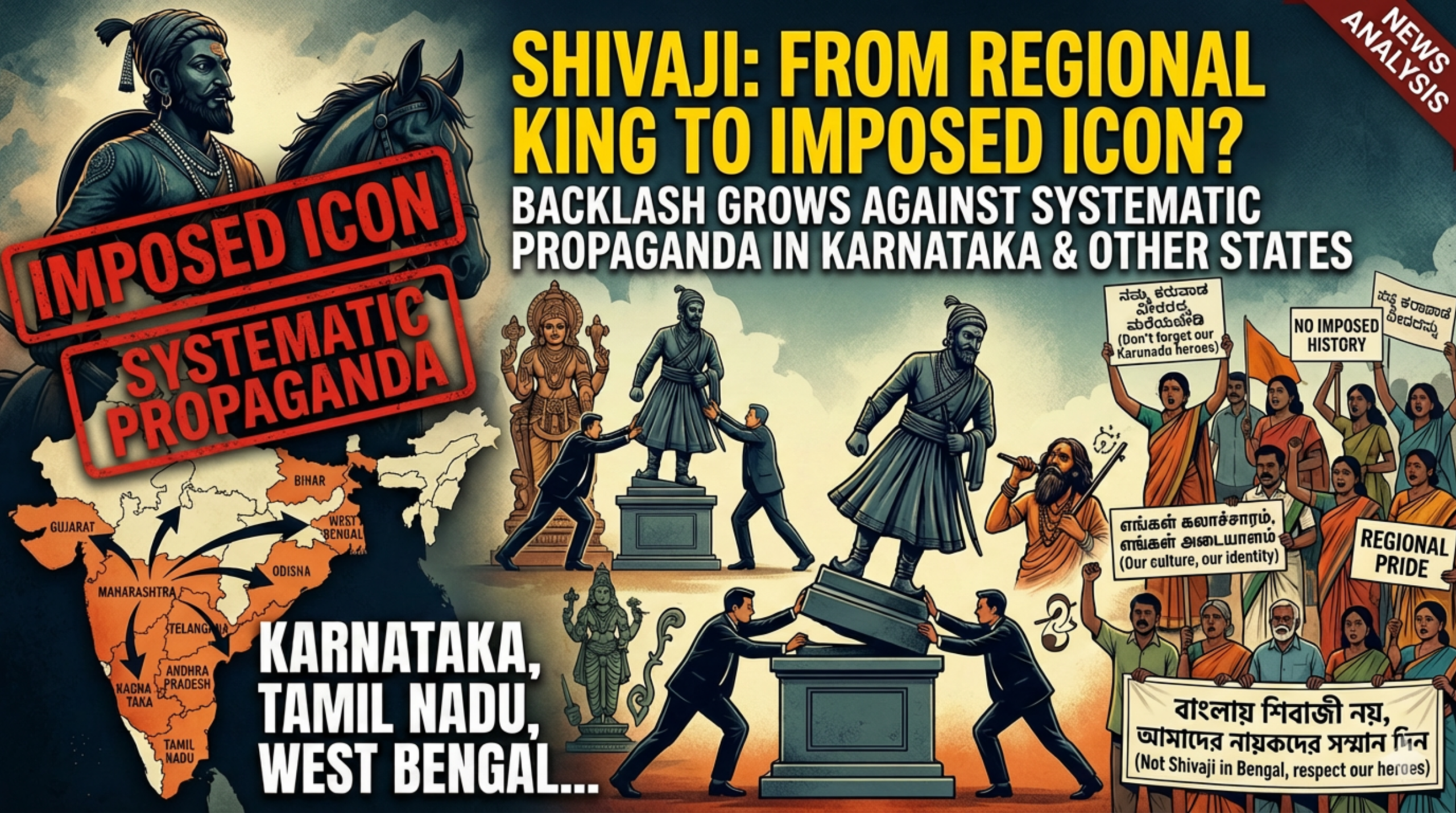
Traditionally venerated as a regional liberator and a martial hero within the Marathi-speaking Deccan, Shivaji has been fundamentally repositioned by the central government as a paramount national deity of statecraft, a universal defender of Sanatan Dharma, and the foundational architect of Hindavi Swaraj (Hindu self-rule) against the imperialism of the Islamic Mughal and Adilshahi empires.1 This state-sponsored homogenization of history, however, encounters profound and often violent friction when exported beyond the ethno-linguistic borders of Maharashtra. The imposition of Shivaji Maharaj as a universal symbol of Indian nationalism has provoked significant rebellion, cultural resentment, and ideological resistance among non-Marathi populations.5
The fundamental contradiction driving this backlash lies in the historical reality of the Maratha Empire’s expansionist policies. While celebrated in Maharashtra as a revolutionary liberator, Shivaji and his subsequent dynastic successors—including the Peshwas—conducted aggressive military campaigns, exacted heavy and coercive economic tributes (specifically the Chauth and Sardeshmukhi), and ruthlessly plundered neighboring kingdoms across the Indian subcontinent.9 For regions such as Gujarat, Bengal, Rajasthan, and Karnataka, the Maratha armies are historically remembered not as fraternal Hindu liberators, but as foreign invaders and predatory overlords who caused immense economic devastation, civilizational trauma, and civilian suffering.7
The attempt to overwrite these deeply ingrained, highly localized regional traumas with a monolithic, religion-centric nationalist narrative raises critical questions regarding the appropriateness, efficacy, and ethical viability of such political strategies. The analysis presented in this comprehensive report conducts an exhaustive study of the ideological mechanisms driving the BJP’s imposition of Shivaji Maharaj, the complex historical realities of Maratha expansionism, and the subsequent socio-political rebellions triggered across non-Marathi states. By examining the intersection of historiography, regional sub-nationalism, memory studies, and political majoritarianism, this report evaluates the socio-political consequences of weaponizing localized history for the purpose of absolute nationalistic homogenization.
The Ideological Framework: Hindutva, Memory, and the Relocation of Icons
To comprehend the profound regional backlash against the nationalization of Shivaji Maharaj, it is imperative to first deconstruct the ideological foundations that compel the BJP to elevate him to the pantheon of supreme national heroes. The phenomenon of utilizing Shivaji for political mobilization is not entirely novel; it traces its origins to the late 19th century when nationalist leaders, most notably Bal Gangadhar Tilak, established the Shivaji festival (alongside the Ganapati festival) in 1895 to unify the masses against British colonial rule.15 Tilak utilized a potent blend of regional Marathi pride and Hindu revivalism, innovating the rashtriya kirtan (nationalist devotional songs) to integrate devotion to God (dev) with devotion to the nation (desh).17 However, the contemporary iteration of this strategy is intrinsically tied to the formalized ideology of Hindutva, as articulated by foundational thinkers like Vinayak Damodar Savarkar and Madhav Sadashiv Golwalkar.19
Within the Hindutva framework, the Indian nation is defined not by secular territoriality, constitutional patriotism, or civic nationalism, but by a shared Hindu cultural and religious identity that views the subcontinent as both fatherland and holy land.20 The historical narrative constructed and propagated by Hindu nationalists requires specific temporal pillars: a “golden age” of ancient Hindu civilization, a subsequent “dark age” characterized by Islamic invasions and tyranny (specifically targeting the Delhi Sultanate and the Mughal Empire), and a heroic resurgence of martial Hindu power.19
Chhatrapati Shivaji Maharaj serves as the ultimate, indispensable archetype for this required resurgence. His establishment of an independent Maratha kingdom in 1674, culminating in his formal coronation (Rajya-abhishek) at Raigad Fort in direct defiance of the Mughal Emperor Aurangzeb and the Adilshahi Sultanate of Bijapur, is interpreted by the BJP not merely as a regional political triumph, but as a monumental civilizational victory for Hinduism.1 Through the lens of social representations theory of history, the Hindu nationalist movement defines modern nationhood by embedding it in this essentializing narrative, utilizing figures like Shivaji to legitimize the exclusion of “foreign” elements (namely Muslims) while consolidating a homogenized Hindu voting bloc.19
The BJP’s overarching strategy, particularly under what political sociologists term “Modi 3.0,” involves the simultaneous contraction and expansion of Hindutva’s footprint—a geographic and sociological “relocation” of the project.2 Because the party seeks to maintain hegemony across a diverse electorate, it must export symbols of martial Hindu triumph to regions that lack their own analogous figures, or where local figures do not fit neatly into the anti-Islamic Hindutva paradigm. The imposition of Shivaji is therefore not a mere historical tribute, but a calculated mechanism of identity entrepreneurship designed to redefine the terms of national political debate, displace competing secular or regional narratives, and establish a unified civilizational identity across all linguistic borders.19
State Apparatus and the Mechanisms of Historical Imposition (2014-2026)
The translation of this ideological imperative into state policy has been executed through a multi-pronged approach involving monumental architecture, the alteration of national symbols, and the aggressive revision of educational curricula. Between 2014 and 2026, the Modi government has institutionalized the narrative of Shivaji as a national savior with unprecedented state backing.
Union Home Minister Amit Shah has been central to this rhetorical framing, explicitly characterizing Shivaji’s legacy as a lifelong, sacred struggle to protect swaraj, swadharma, and swabhasha (self-rule, own religion, and own language).1 In high-profile public addresses, Shah has emphasized Shivaji’s role in protecting Hindu pilgrimage sites and conveying a definitive message to the Mughals that Sanatan Dharma could not be extinguished by the demolition of temples.1 Prime Minister Narendra Modi has similarly and frequently invoked Shivaji’s governance model as a direct inspiration for modern statecraft, consistently positioning the Maratha king as a visionary leader whose unwavering commitment to public welfare leaves a legacy that shapes modern “national consciousness”.3
This rhetorical repositioning is physically manifested in the proliferation of monumental architecture outside of Maharashtra. A prime example is the unveiling of a 21-foot-tall equestrian statue of Shivaji Maharaj in Gandhinagar, Gujarat, constructed by the Maharashtra Samaj, which Union Home Minister Shah declared would inspire the youth of Gujarat for generations.1 Furthermore, the central government has embedded this narrative into the highest echelons of state symbolism. In a highly publicized move to “decolonize” the military, the Modi government removed the St. George’s Cross from the flag of the Indian Navy, replacing it with an octagonal design directly inspired by the royal seal (Rajmudra) of Shivaji Maharaj, thereby officially consecrating him as the progenitor of Indian naval power on a national scale.1
| Mechanism of Imposition | State Action and Implementation | Strategic Objective |
| Monumental Architecture | Unveiling massive equestrian statues across non-Marathi states (e.g., Gandhinagar, Gujarat) and coastal regions (Sindhudurg, Maharashtra).1 | Physical occupation of public space; creating sites of nationalist pilgrimage; visually reinforcing Hindutva hegemony. |
| Symbolic Decolonization | Replacing the St. George’s Cross on the Indian Navy ensign with Shivaji’s octagonal royal seal.1 | Institutionalizing Shivaji as the father of national maritime security; linking pre-colonial Hindu power to modern state defense. |
| Curricular Revision | Expanding Shivaji’s history in CBSE Class 8 textbooks from a 68-word summary to a 22-page chapter titled “The Rise of Marathas”.29 | Top-down pedagogical indoctrination; ensuring the next generation internalizes the Hindutva-approved narrative uniformly across all states. |
| Toponymic Alteration | Renaming British-era or Islamic infrastructure (e.g., attempting to rename Residency Kothi in Indore to Shivaji Kothi).27 | Erasing colonial and Islamic historical markers to reclaim geographic identity through Maratha nomenclature. |
The most potent and enduring tool for this historical imposition, however, has been the systematic revision of educational curricula, which serves to mandate the veneration of Shivaji upon students nationwide. The BJP government successfully advocated for the massive expansion of Shivaji’s history within the Central Board of Secondary Education (CBSE) syllabus, managed by the National Council of Educational Research and Training (NCERT).29 In Class 8 textbooks, the section dedicated to the Maratha Empire was aggressively expanded from a mere 68 words to over 2,200 words, spanning 22 pages.29 State ministers explicitly acknowledged that this expansion was driven by the government’s sensitivity to Shivaji’s history, noting that his administrative model inspires PM Modi’s policies.30
Conversely, localized educational boards that fail to provide sufficient glorification face intense backlash. When the Maharashtra International Education Board (MIEB) attempted a concept-based curriculum that briefly omitted Shivaji’s life story from Class IV textbooks (planning to introduce it comprehensively in Class VI), it triggered massive political outrage, forcing the administration to defend its pedagogical choices against accusations of anti-nationalism.33 The message from the state is unequivocal: the veneration of Shivaji is not a matter of objective regional history, but a mandatory requirement of national patriotism.
Deconstructing the Icon: Historiographical Realities vs. Nationalist Myth-Making
The political utility of Shivaji Maharaj relies entirely upon a highly selective, heavily sanitized reading of history. The imposition of this figure on non-Maharashtrians often fails because the state-sponsored myth contradicts the established historical records maintained by scholars, historians, and academics across India.24 Academic analyses present a vastly more complex, pragmatic, and secular figure than the monolithic Hindu crusader projected by modern right-wing nationalism.36
Historians and sociologists, notably the late Govind Pansare in his seminal and widely translated work Shivaji Kon Hota? (Who Was Shivaji?), have systematically deconstructed the myth of Shivaji as a religious zealot.36 Pansare’s rigorous application of historical methodology reveals that Shivaji’s military campaigns were driven fundamentally by the imperatives of statecraft, economic necessity, and political survival within a fractured feudal landscape, rather than a theological desire to eradicate Islam.36 Historical evidence demonstrates that Shivaji’s military and administrative apparatus was highly inclusive and meritocratic. His army, including his vital naval forces, artillery units, and cavalry, employed thousands of Muslims.36 His chief adversaries were often fellow Hindu monarchs, Rajput vassals serving the Mughals, and rival Maratha chieftains, while his alliances frequently crossed religious lines depending entirely on geopolitical exigencies.18
Furthermore, Shivaji’s approach to religion was marked by profound tolerance, a stark contrast to the exclusionary policies of modern Hindutva. Contemporary records, including those written by his chief justice, Raghunath Pandit Rao, indicate strict royal edicts guaranteeing religious freedom for all subjects, expressly forbidding the destruction of mosques or the harassment of Islamic clergy.36 One of the most significant historical documents illuminating his worldview is his famous letter to Emperor Aurangzeb, drafted in Persian by his secretary Nila Prabhu, formally protesting the re-imposition of the Jaziya tax on non-Muslims.9 In this bitingly sarcastic yet philosophically profound letter, Shivaji invoked the tolerant policies of Emperor Akbar and argued that the Quran dictates that God is the “Lord of all men,” not just the “Lord of Muhammadans”.9 He criticized the tax as a violation of divine equality, asserting that Aurangzeb’s bigotry was tantamount to finding fault with God’s design.9
While Shivaji undoubtedly took immense pride in his Hindu identity and sought to protect Hindu institutions from desecration, elevating him to the status of a pan-Indian Hindu nationalist fundamentally misrepresents the feudal, fragmented, and highly pragmatic nature of 17th-century South Asian politics.15 As Pansare argues, neither Hindu nationalism nor the mission of spreading Islam inspired the standing armies of the feudal period; loyalty to the state and the master who provided sustenance was the paramount social practice.36
The friction across India arises precisely when the BJP strips away this complex, secular statecraft to present a flattened, anti-Muslim warrior-king. When this ideologically modified avatar is imposed upon non-Marathi states—states that directly suffered under the economic extraction policies of the Maratha Empire—the cognitive dissonance is acute. The historical reality of the Maratha Empire was not one of pan-Hindu liberation, but of aggressive, often ruthless imperial expansion.2
The Economics of Empire: Chauth, Sardeshmukhi, and the Predatory State
To understand the resentment harbored by non-Marathi states, it is necessary to examine the economic engines of the Maratha Empire. The geopolitical imperatives of the Maratha state in the late 17th and 18th centuries necessitated the aggressive extraction of capital to fund sustained military campaigns and maintain a massive standing army. The Maratha state’s survival and expansion depended heavily on the extraction of wealth from territories outside its direct administrative control.12
This extraction was formally institutionalized through the Chauth—a demand for one-fourth of the standard land revenue of a targeted territory—and the Sardeshmukhi, an additional ten percent demand based on the claim of hereditary paramountcy.12 These were not voluntary contributions to a unified Hindu cause; they were protection rackets. Refusal by neighboring kingdoms or Mughal provinces to pay these exorbitant tributes resulted in devastating military raids, utilizing the famous Maratha tactic of Ganimi Kava (guerrilla warfare and rapid cavalry strikes).3
The imposition of Shivaji as a national savior therefore forces non-Marathi populations to celebrate historical figures and a military apparatus responsible for the economic ruination and sacking of their ancestral cities. This has led to profound, multi-faceted rebellions against the BJP’s nationalistic homogenization across various regions, each informed by its own specific historical trauma.
Regional Rebellions and the Resurgence of Sub-Nationalism
Maratha attacks on temples and towns of Karnataka – https://www.google.com/maps/d/viewer?mid=1oEMVzjc_L5b2vSE2Sflz9bMVO1WYUYSi&usp=sharing: The Nationalization of Chhatrapati Shivaji Maharaj: Evaluating the BJP’s Deployment of a Regional Icon and the Socio-Political BacklashThe assertion that Shivaji and the subsequent Maratha Empire fought for the liberation of all Hindus is violently contradicted by the historical experiences of diverse Indian regions. The attempt to nationalize Shivaji has not resulted in the desired unity; instead, it has catalyzed a resurgence of regional sub-nationalism, as states weaponize their own local histories to resist the imposition of Marathi-centric Hindutva.
Gujarat: The Plunder of Surat and the Contradictions of Memory
The historical memory of Gujarat presents a direct and glaring challenge to the benevolent portrayal of Shivaji. In January 1664, facing severe financial shortages after years of warfare with the Mughal Nawab Shaista Khan—who had occupied and devastated Maratha territories around Pune, leaving Shivaji with no revenue to maintain his army—Shivaji required vast capital.9 He targeted Surat, the wealthiest port city of the Mughal Empire and the central hub of maritime trade in the Arabian Sea, located in present-day Gujarat.11
The sack of Surat lasted for nearly six days. According to historical records by figures like James Grant Duff, the Maratha forces descended upon the city so rapidly that the civilian population had no opportunity to flee.11 The Mughal Governor, Inayat Khan, coward-like, fled to the local fort, leaving the city defenseless.9 Two-thirds of the prosperous city was burnt to the ground, and immense wealth was violently extracted from Mughal treasuries, foreign trading posts, and private merchants—most of whom were Hindus and Jains.11 While some narratives emphasize Shivaji’s restraint—such as sparing the property of a charitable merchant named Mohandas Pareikh and the habitation of the Capuchin missionary Father Ambrose—the broader historical reality was one of violent economic extraction that traumatized the local Gujarati populace.9 The event even triggered what is considered the first mercantile strike in Indian history in 1669, led by figures like Virji Vora (then the world’s richest merchant) and Bhimji Parekh, demonstrating the organized power of the Gujarati merchant class in response to economic and religious instability.38
In the modern political landscape, the BJP has attempted to heavily sanitize this event to prevent the alienation of its most crucial electoral base: the Gujarati voter. During a 2014 visit to Raigad, Narendra Modi argued that Shivaji did not “loot” Surat, but rather heroically plundered Aurangzeb’s treasury with the help of local citizens to fund public welfare, comparing him to a “Robin Hood”.40 This historical revisionism has been met with severe skepticism by professional historians, who point out that Surat was a cosmopolitan mercantile hub and the raid indiscriminately devastated local Hindu and Jain trade.40 While overt political protests against Shivaji in Gujarat are subdued due to the BJP’s overwhelming hegemony in the state, the historical fact of the Surat plunder remains a silent, irreconcilable contradiction in the Hindutva narrative of cross-regional Hindu solidarity.11 The imposition forces Gujaratis to celebrate the destruction of their own historical economic capital.
Bengal: The Trauma of the Bargi Invasions
Nowhere is the historical resentment against Maratha expansionism more deeply entrenched, culturally codified, and politically explosive than in Bengal. Between April 1742 and March 1751, the Maratha forces from the Kingdom of Nagpur, commanded by Raghuji I Bhonsle and his generals like Bhaskar Pandit, launched five distinct and brutal invasions into the Bengal Subah.7 These raiders, known locally as Bargis (a corruption of bargir, referring to the lowest tier of lightly armed Maratha cavalrymen), were seeking to mercilessly enforce the collection of Chauth following the decline of Mughal authority and leveraging the betrayal of the local Persian peer Mir Habib.10
The Bargi invasions were catastrophic for the Bengali population, resulting in widespread massacres, the absolute destruction of agriculture, and the collapse of the regional economy.10 Contemporary Bengali accounts, such as the Maharashta Purana, document unspeakable atrocities committed against civilians—including the mutilation of women and the slaughter of fleeing peasants—regardless of their Hindu or Muslim identity.7 The trauma was so profound that it became permanently embedded in Bengali folklore; to this day, traditional Bengali lullabies (“Khuku ghumalo, para juralo, bargi elo deshe…”) invoke the terror of the Maratha raiders to put children to sleep.10 To protect their territories from the marauding cavalry, the local population and the British East India Company were forced to construct the massive “Maratha Ditch” around Calcutta.7 The conflict only concluded when Nawab Alivardi Khan, exhausted by a decade of warfare, ceded the territory of Orissa to the Marathas and agreed to pay an annual tribute of 1.2 million rupees.10
Consequently, the BJP’s attempt to impose Shivaji and Maratha glory upon Bengal has met with fierce ideological, cultural, and political rebellion.42 Bengali sub-nationalist organizations, most notably Bangla Pokkho, vehemently reject the imposition of Maratha icons, citing the Bargi raids as incontrovertible evidence that the Marathas were imperialist oppressors and looters rather than Hindu liberators.7 For Bengali nationalists, the BJP’s promotion of Shivaji is perceived not as religious unification, but as an extension of Hindi-belt and Western Indian cultural imperialism. It is viewed as an insidious attempt to erase Bengal’s distinct historical suffering and subsume its unique, syncretic identity into an artificial, homogenizing Hindutva framework dictated from New Delhi.2 The historical reality of the Bargis completely shatters the BJP’s narrative of a unified Hindu past in the eastern theater.
Karnataka: Sub-Nationalism and the Clash of Statues
In the southern state of Karnataka, the imposition of Shivaji has manifested in violent street-level clashes, highly polarized political rhetoric, and the destruction of public property. This unrest is exacerbated by longstanding ethno-linguistic border disputes between Maharashtra and Karnataka, specifically concerning the Belagavi (Belgaum) district, which harbors a significant Marathi-speaking population but resides administratively within Karnataka.45
The resentment in Karnataka stems from both historical memory—Shivaji’s forces actively campaigned in the region, bringing areas like Hubballi under attack and looting local wealth—and from contemporary linguistic chauvinism.5 The pushback is largely spearheaded by pro-Kannada organizations, such as the Karnataka Rakshana Vedike, who view the erection of Shivaji statues by the Maharashtra Ekikaran Samiti (MES) not as a tribute to a national hero, but as a direct affront to Kannada sovereignty and a mechanism of Marathi linguistic imperialism.45
This simmering tension reached a violent boiling point in recent years through a literal “clash of statues.” In 2020 and 2021, intense riots broke out in Belagavi over the installation of monuments at the Peeranwadi junction. Kannada activists sought to install the statue of Sangolli Rayanna—a revered 19th-century local Kuruba freedom fighter who fought valiantly against the British East India Company to protect the Kittur principality—at a prominent intersection previously dominated by an unofficial statue of Shivaji.48 When authorities delayed the installation, activists took matters into their own hands, leading to clashes with Marathi-speaking groups.48 Retaliatory vandalism rapidly escalated across the state lines; statues of Shivaji were desecrated with ink in Bengaluru, and in response, statues of Sangolli Rayanna were damaged in Belagavi, alongside the provocative burning of the Karnataka state flag by alleged MES activists.45 State Ministers, such as K S Eshwarappa, issued highly inflammatory statements demanding that those who defaced Rayanna and the Kannada flag be “shot dead,” indicating the extreme volatility of the situation.50
The BJP finds itself in a highly precarious, almost untenable position in Karnataka. To appease its core Marathi constituency in Maharashtra and maintain its overarching national Hindutva narrative, it must revere Shivaji unconditionally. However, to maintain its fragile political foothold in Karnataka against the Indian National Congress, state-level BJP leaders must actively cater to Kannada sub-nationalism. This has led to astonishing feats of historical revisionism by Karnataka politicians. For instance, former Deputy Chief Minister Govind Karjol controversially claimed that Shivaji’s ancestors, specifically a forefather named Belliyappa, were actually Kannadigas who migrated from the Soratur village in Gadag district to Maharashtra due to drought.46 This was a desperate attempt to culturally appropriate the Maratha king to soothe local sentiments and neutralize Shiv Sena’s attacks.46 Despite these political maneuvers, the resistance to Shivaji’s imposition remains fierce, definitively demonstrating the absolute limits of a unitary nationalist narrative in a linguistically and culturally divided geography.2
Rajputana (Rajasthan): Resentment Over Maratha Exploitation
While modern Rajasthan is deeply integrated into the BJP’s contemporary Hindu nationalist electoral coalition, the historical reality of Maratha-Rajput relations was marked by severe economic exploitation and deep-seated, violent resentment.12 Following the death of Aurangzeb and the weakening of the Mughal center, the Marathas rapidly advanced into the Doab, Gujarat, and Malwa, eventually penetrating the Rajputana dominions.14
Initially, the Marathas were formally invited into the region; Rajput rulers utilized them as mercenaries to intervene in complex internal succession disputes, such as the domestic feuds in Bundi, Jaipur, Jodhpur, and Mewar.53 However, the Marathas quickly shifted from being paid auxiliaries to predatory overlords. Viewing Rajasthan—a fundamentally deficit state—as a lucrative source of revenue, they demanded exorbitant Chauth from the Rajput rajas, heavily draining the local economies.12
The relentless economic drain and the arrogant, self-centered conduct of the Maratha generals (specifically from the Sindhia and Holkar clans) led to immense hostility.12 In 1734, prominent Rajput rulers, orchestrated by the visionary Sawai Jai Singh of Jaipur, convened the historic Hurda Conference. The objective was to forge a united Rajput front to expel the Marathas from Rajasthan, though internal divisions and jealousies ultimately doomed the concerted effort.52 The resentment against Maratha hegemony eventually culminated in massive, violent uprisings. Most notably, in 1751, the citizens and followers of Madho Singh in Jaipur rose up and systematically massacred approximately 5,000 Maratha soldiers and couriers.12 Similarly, the powerful Maratha general Jayappa Sindhia was assassinated by the forces of Marwar.12
The historical record, extensively documented by eminent historians like Jadunath Sarkar, illustrates beyond doubt that the Maratha presence in Rajasthan was viewed as an oppressive imperial force, not as a unifying Hindu brotherhood.12 The modern imposition of Shivaji and the glorification of the Maratha Empire therefore requires an intentional, state-mandated amnesia regarding the predatory policies his successors inflicted upon fellow Hindu kingdoms.12
Tamil Nadu: Dravidian Exceptionalism and the Tipu Sultan Antithesis
In Tamil Nadu, the resistance to the imposition of Shivaji Maharaj is fundamentally ideological and deeply rooted in the decades-old Dravidian movement, which structurally and philosophically opposes what it perceives as Northern, Aryan, and Brahmanical hegemony.54 Spearheaded originally by Periyar E. V. Ramasamy’s Self-Respect Movement and the Dravidar Kazhagam (DK), and carried forward by powerful regional political parties like the DMK and AIADMK, Tamil Nadu’s political landscape is inherently suspicious of the BJP’s Hindutva project.27
In this southern theater, Shivaji is viewed not primarily through the lens of historical military raids, but as an alien cultural import utilized by the BJP to enforce a pan-Indian, Hindi-centric Hindu identity at the expense of India’s constitutional federal diversity.55 The friction regarding historical interpretation was sharply illuminated during a massive political controversy involving Maharashtra Congress leader Harshwardhan Sapkal. Sapkal drew public parallels between the valor of Chhatrapati Shivaji Maharaj and the 18th-century Mysuru ruler Tipu Sultan.58 Sapkal argued that both leaders demonstrated a profound spirit of resistance and Swarajya—Shivaji against the tyranny of the Mughals, and Tipu Sultan against the imperialism of the British East India Company.58
This historical comparison provoked absolute fury from the BJP and the Shiv Sena. Maharashtra Chief Minister Devendra Fadnavis vehemently condemned the comparison, stating that “invaders” who “butchered Hindus” could never be accepted as national icons, and that equating the founder of Hindavi Swarajya with Tipu Sultan was an unforgivable insult to Maharashtra.60 The backlash was visceral; BJP leaders like Nitesh Rane went as far as demanding that any public squares named after Tipu Sultan in Maharashtra be physically uprooted and “built in Pakistan”.62 Conversely, politicians opposing the BJP, such as Congress spokesperson Sachin Sawant, pointed out the party’s glaring hypocrisy, noting that BJP leaders had previously supported naming infrastructure after Tipu Sultan (such as a 2012 resolution in Akola and a 2013 proposal in Mumbai) before adopting a harder, calculated polarization agenda to divide voters.63
This conflict perfectly encapsulates the fundamental incompatibility of the BJP’s unified nationalist narrative with pluralistic regional perspectives. For the Hindutva framework, Shivaji is the unquestionable, flawless hero and Tipu Sultan the villainous Islamic tyrant.59 However, for many in Southern India and within secular political spheres, Tipu Sultan represents an indigenous, technologically advanced bulwark against British colonialism, while Shivaji represents an external northern force.60 The aggressive, uncompromising reaction of the BJP to this comparative history demonstrates the rigid exclusivity of their historical project, which further alienates Dravidian political sensibilities that historically reject imposed northern narratives, much like they resisted the compulsory imposition of the Hindi language in 1965.56
Sociological Consequences: The Nationalization of Politics and Federal Friction
The imposition of Chhatrapati Shivaji Maharaj upon non-Marathi populations must be analyzed through the sociological framework of the “nationalization of politics.” Political science paradigms suggest that attempting to create a homogenous national electorate often requires the systemic suppression of localized, heterogeneous identities and shared concrete regional knowledge.66 When a ruling party acting as an “identity entrepreneur” attempts to forcefully embed a regional icon into the national consciousness, it inevitably and permanently alters the socio-political dynamics of the state.19
The BJP’s strategy relies upon a “psychological centralization” of the Indian populace, demanding that citizens prioritize a national religious identity over local ethnic or linguistic affiliations.21 By elevating Shivaji to the status of a national deity, the party seeks to create a functional equivalence of identity across diverse geographies, asserting that the shared Hindu-ness of the population supersedes regional historical trauma.2 The sociological consequence of this strategy, however, is the inadvertent but powerful stimulation of reactive regional sub-nationalisms.2
When the state mandates the veneration of a figure historically responsible for regional suffering, it forces the local populace into a state of profound historical cognitive dissonance.13 This creates a vacuum of authentic cultural representation. This vacuum is rapidly filled by regional political actors—such as Bangla Pokkho in Bengal or the Dravidian parties in Tamil Nadu—who actively weaponize local history and local icons against the centralizing force.8 Consequently, the imposition does not forge the desired unity; rather, it exacerbates political polarization. Research indicates that the shift from local to national political narratives relies upon abstract, moralized, and power-centric language that inherently fosters anger and deepens partisan animosity.68
Furthermore, the vulnerability of this imposed narrative is exposed when the physical manifestations of the project fail. The recent collapse of the 35-foot statue of Shivaji Maharaj in Sindhudurg, Maharashtra—unveiled by PM Modi himself—triggered massive protests by the opposition Maha Vikas Aghadi (MVA), including the ‘Jode Maro Andolan’ (Hit with Footwear protest).70 The opposition successfully framed the collapse not just as an engineering failure, but as an unforgivable insult to the Maratha warrior born of rampant government corruption, forcing the Prime Minister to issue a public apology.70 This incident illustrates that even within Maharashtra, the BJP’s monopolization of Shivaji is highly contested, making the export of this flawed monopolization to other states even more socially precarious.
Evaluating the “Appropriateness” of Nationalist Historical Imposition
Evaluating the appropriateness of imposing Chhatrapati Shivaji Maharaj upon non-Marathi populations requires strictly distinguishing between short-term political utility and long-term historical and constitutional integrity.
From the perspective of raw political strategy and electoral arithmetic, the BJP’s deployment of Shivaji is highly effective within its core constituencies. It successfully consolidates the Hindu majority by providing a potent, easily digestible symbol of martial resistance and civilizational pride. It fulfills the psychological requirements of a majoritarian nationalist project by delineating clear in-groups (patriotic Hindus) and out-groups (Muslims and secular political opponents), thereby redefining the terms of Indian political debate.2
However, from sociological, historiographical, and ethical standpoints, the appropriateness of this imposition is deeply flawed and actively detrimental to the Indian republic.
First, it constitutes an act of historical violence against the subjugated regions. Demanding that Bengalis, Gujaratis, Kannadigas, and Rajputs venerate the leader of an empire that historically plundered their lands, extracted their wealth, and massacred their ancestors requires the systemic, state-mandated erasure of their regional suffering.7 It elevates the historical narrative of the aggressor (the Maratha Empire) while intentionally silencing the historical narrative of the victims, strictly on the basis of a shared modern religious identity.
Second, the imposition relies on the severe distortion of Shivaji’s actual historical record. Transforming a highly pragmatic, relatively secular 17th-century monarch—who employed thousands of Muslims, respected Islamic holy sites, wrote eloquently about the equality of all religions before God, and primarily fought fellow Hindu kings for territorial expansion—into a modern mascot for exclusionary Hindutva politics represents a profound corruption of historical epistemology.22 As scholars have noted, the true, nuanced history of Shivaji’s statecraft is deliberately sacrificed to accommodate the ideological rigidity required by modern right-wing nationalism.21
Third, in a highly diverse, federal republic like India, the imposition of a singular cultural or historical narrative is inherently destabilizing. India’s social fabric and constitutional democracy are maintained through the delicate accommodation of pluralistic, composite identities.55 The aggressive promotion of a standardized, Hindutva-approved version of history via CBSE curricula and monumental architecture provokes reactionary sub-nationalisms, threatening the broader cohesion of the state.2 The riots in Belagavi over Sangolli Rayanna, the ideological warfare in Tamil Nadu regarding Tipu Sultan, and the rise of Bengali linguistic nationalism are direct, undeniable symptoms of the friction caused when a diverse society is forced into a monolithic ideological mold.43
Conclusion
The BJP-led government’s endeavor to elevate Chhatrapati Shivaji Maharaj from a regionally revered Maratha king to the ultimate, universal symbol of Indian national identity represents a profound intersection of historical revisionism and majoritarian politics. The current administration has utilized every apparatus of the state—from the erection of monumental statues and the alteration of military insignias to the sweeping, top-down revision of central educational curricula—to institutionalize the narrative of Hindavi Swaraj as the unassailable bedrock of modern Indian nationalism.
However, an exhaustive analysis of both historical records and contemporary political sociology indicates that this imposition is fundamentally incompatible with the lived historical realities and cultural memories of non-Marathi populations. The Maratha Empire’s legacy outside the Deccan plateau is intrinsically tied to violent military expansion, predatory economic extraction via the Chauth system, and devastating incursions, most notably the traumatic Sack of Surat in Gujarat, the bloody Bargi invasions of Bengal, and the systemic draining of the Rajputana states. By demanding the universal veneration of Shivaji, the central government forces diverse ethno-linguistic groups to subjugate their own historical traumas and overwrite their own regional icons—such as Sangolli Rayanna in Karnataka or Nawab Alivardi Khan in Bengal—in favor of a homogenized, religion-centric narrative dictated by New Delhi.
Ultimately, while the weaponization of Shivaji Maharaj serves the immediate political utility of consolidating a Hindu nationalist vote bank, it is historically reductive and sociologically inappropriate for a pluralistic civilization. It replaces the complex, pragmatic, and remarkably inclusive statecraft of the historical Shivaji with a sanitized, two-dimensional mascot of religious supremacy. In doing so, it inevitably provokes intense regional resentment, inflames linguistic sub-nationalisms, and undermines the very national unity and federal harmony it purports to build. The ongoing political and cultural rebellion against this imposition across India stands as a testament to the enduring resilience of regional historical memory against the homogenizing forces of the centralized state.
Works cited
- Union Home Minister and Minister of Cooperation, Shri Amit Shah unveils the equestrian statue of Chhatrapati Shivaji Maharaj constructed by Maharashtra Samaj Gandhinagar in Gandhinagar, Gujarat – PIB, accessed on February 27, 2026, https://www.pib.gov.in/PressReleasePage.aspx?PRID=2229370®=3&lang=1
- Full article: Relocations of Hindutva: Hindu Nationalism Under Modi 3.0 – Taylor & Francis, accessed on February 27, 2026, https://www.tandfonline.com/doi/full/10.1080/08039410.2025.2599112
- (PDF) Chhatrapati Shivaji Maharaj: Architect of Hindavi Swarajya and early Indian Sovereignty – ResearchGate, accessed on February 27, 2026, https://www.researchgate.net/publication/397838962_Chhatrapati_Shivaji_Maharaj_Architect_of_Hindavi_Swarajya_and_early_Indian_Sovereignty
- PM Modi pays tribute to Chhatrapati Shivaji Maharaj on his jayanti | DD News, accessed on February 27, 2026, https://ddnews.gov.in/en/pm-modi-pays-tribute-to-chhatrapati-shivaji-maharaj-on-his-jayanti/
- Hero, Tyrant or just another king? Shivaji’s rule in Karnataka, accessed on February 27, 2026, https://historyofmysuru.blogspot.com/2017/12/hero-tyrant-or-just-another-king_26.html
- Shiv Sena alleges Karnataka govt of removing Shivaji statue, attacks BJP for being silent, accessed on February 27, 2026, https://www.coastaldigest.com/india-top-story/shiv-sena-alleges-karnataka-govt-removing-shivaji-statue-attacks-bjp-being-silent?page=6
- Maratha invasions of Bengal – Wikipedia, accessed on February 27, 2026, https://en.wikipedia.org/wiki/Maratha_invasions_of_Bengal
- The Mahatma Misunderstood: the politics and forms of South Asian literary nationalism, accessed on February 27, 2026, https://escholarship.org/uc/item/77d6z8xw
- Did Shivaji Maharaj “really plunder” Surat – Discovering Mughal, Rajput & Mauryan History, accessed on February 27, 2026, http://mariam-uz-zamani.blogspot.com/2015/08/did-shivaji-maharaj-really-plunder-surat.html
- Maratha Raids – Banglapedia, accessed on February 27, 2026, https://en.banglapedia.org/index.php/Maratha_Raids
- Sack of Surat – Wikipedia, accessed on February 27, 2026, https://en.wikipedia.org/wiki/Sack_of_Surat
- First Phase (1741-52) – The Maratha Advance into Doab and Punjab – Medieval India History Notes – Prepp, accessed on February 27, 2026, https://prepp.in/news/e-492-first-phase-1741-52-the-maratha-advance-into-doab-and-punjab-medieval-india-history-notes
- First Maratha invasion of Bengal – Wikipedia, accessed on February 27, 2026, https://en.wikipedia.org/wiki/First_Maratha_invasion_of_Bengal
- 33.(MEDIEVAL INDIA) THE MARATHA BID FOR SUPREMACY – self study history, accessed on February 27, 2026, https://selfstudyhistory.com/2015/01/03/33-medieval-india-the-maratha-bid-for-supremacy/
- Shivaji and the Politics of History | MANAS, accessed on February 27, 2026, https://southasia.ucla.edu/history-politics/mughals-and-medieval/shivaji-politics-history/
- Shivaji And The Indian National Movement, accessed on February 27, 2026, https://ia800701.us.archive.org/33/items/in.ernet.dli.2015.99319/2015.99319.Shivaji-And-The-Indian-National-Movement_text.pdf
- A Very Short History of South Asia: Six Key Themes and a Timeline, accessed on February 27, 2026, https://sai.columbia.edu/content/very-short-history-south-asia-six-key-themes-and-timeline
- The Development of Hindu Nationalism (Hindutava) in India in the Twenteith Century: A Historical Perspective – R Discovery, accessed on February 27, 2026, https://discovery.researcher.life/article/the-development-of-hindu-nationalism-hindutava-in-india-in-the-twenteith-century-a-historical-perspective/b41e8d04a86d394a913e559b1dc56d3e
- Lessons From the Past for the Future: The Definition and Mobilisation of Hindu Nationhood by the Hindu Nationalist Movement of India – Journal of Social and Political Psychology, accessed on February 27, 2026, https://jspp.psychopen.eu/index.php/jspp/article/view/5027/5027.html
- Hind Swaraj vs Hindu Rashtra, accessed on February 27, 2026, https://www.thehindu.com/opinion/lead/hind-swaraj-vs-hindu-rashtra/article6201620.ece
- Contemporary Populism in India: Assessing the Bharatiya Janata Party’s Ideological Features – e-Repositori UPF, accessed on February 27, 2026, https://repositori.upf.edu/bitstreams/435b1f0b-bca9-4ccb-a6d5-d74c61cbe11b/download
- Hindutva’s Dangerous Rewriting of History – OpenEdition Journals, accessed on February 27, 2026, https://journals.openedition.org/samaj/6636
- Shivaji – Wikipedia, accessed on February 27, 2026, https://en.wikipedia.org/wiki/Shivaji
- The Marathas: Chatrapati Shivaji Maharaj – An Analysis – The History Files, accessed on February 27, 2026, https://www.historyfiles.co.uk/FeaturesFarEast/India_EarlyModern_Marathas07.htm
- The Burden of Legacy – OpenEdition Journals, accessed on February 27, 2026, https://journals.openedition.org/samaj/10291
- Maratha Empire – Wikipedia, accessed on February 27, 2026, https://en.wikipedia.org/wiki/Maratha_Empire
- Modern Indian History-Events and Personalities – CivilsDaily, accessed on February 27, 2026, https://www.civilsdaily.com/story/modern-indian-history-events-and-personalities/
- PM Narendra Modi unveils the statue of Shri Chhatrapati Shivaji Maharaj in Sindhudurg, Maharashtra | Bharatiya Janata Party, accessed on February 27, 2026, https://www.bjp.org/video-gallery/pm-narendra-modi-unveils-statue-shri-chhatrapati-shivaji-maharaj-sindhudurg
- CBSE expands Chhatrapati Shivaji Maharaj’s history in Class 8 textbook, accessed on February 27, 2026, https://www.hindujagruti.org/news/207654.html
- New CBSE Class 8 curriculum to have over 20 pages on rise of Marathas, says Minister, accessed on February 27, 2026, https://education.economictimes.indiatimes.com/news/government-policies/cbse-curriculum-now-includes-detail-history-of-chhatrapati-shivaji-maharaj-maharashtra-cm/125959976
- Indore Residency Kothi Renamed to Shivaji Kothi Sparks Political Controversy – The Times of India, accessed on February 27, 2026, https://timesofindia.indiatimes.com/city/indore/indore-residency-kothi-renamed-to-shivaji-kothi-sparks-political-controversy/articleshow/114433822.cms
- Pedagogical Curricula and Educational Media: The Malignancy of Saffronised Otherisation in India – ejournals, accessed on February 27, 2026, https://ejournals.eu/en/journal_article_files/full_text/018ecedd-9e01-739d-ba41-7d404eb174c5/download
- Teachers upset as Maharashtra international board ‘omits’ Chhatrapati Shivaji Maharaj story | Mumbai News – Times of India, accessed on February 27, 2026, https://timesofindia.indiatimes.com/city/mumbai/teachers-upset-as-maharashtra-international-board-omits-chhatrapati-shivaji-maharaj-story/articleshow/71642517.cms
- English Factory Records on Shivaji – 1659 to 1682, accessed on February 27, 2026, https://ia601506.us.archive.org/7/items/EnglishFactoryRecordsOnShivaji-1659To1682/EnglsihRecordsOnShivaji_text.pdf
- Shivaji and his times – Rare Book Society of India, accessed on February 27, 2026, https://www.rarebooksocietyofindia.org/book_archive/196174216674_10155903990831675.pdf
- Shivaji: Hindutva Icon or Secular Nationalist? – INDIAN HISTORY COLLECTIVE, accessed on February 27, 2026, https://indianhistorycollective.com/shivaji-hindutva-icon-or-secular-nationalist-religioninindia-shivajimaharaj-hindustan-aurangzebandshivaji-marathaempire-jaziyatax-aurangzeb/
- Full text of “THE HISTORY OF SHIVAJI THE GRAND REBEL” – Internet Archive, accessed on February 27, 2026, https://archive.org/stream/dli.bengal.10689.13490/10689.13490_djvu.txt
- How Gujarati Merchants Made Aurangzeb Apologize: The 1669 Surat Boycott That Changed History – YouTube, accessed on February 27, 2026, https://www.youtube.com/watch?v=qLezfPWWmUE
- (PDF) The Unrest and Protest Movements in Nineteenth Century Gujarat – ResearchGate, accessed on February 27, 2026, https://www.researchgate.net/publication/344347430_The_Unrest_and_Protest_Movements_in_Nineteenth_Century_Gujarat
- Shivaji was a Robin Hood in plundering Surat: Modi in Raigad – Mumbai Mirror, accessed on February 27, 2026, https://mumbaimirror.indiatimes.com/mumbai/other/shivaji-was-a-robin-hood-in-plundering-surat-modi-in-raigad/articleshow/28463192.html
- Indian Nationalism and the Historical Fantasy of a Golden Hindu Period | Cato Institute, accessed on February 27, 2026, https://www.cato.org/policy-analysis/indian-nationalism-historical-fantasy-golden-hindu-period
- BJP Leaders Attacked in West Bengal Amid Flood Relief Visit, Tensions Escalate – YouTube, accessed on February 27, 2026, https://www.youtube.com/watch?v=BnmKABRGjGg
- What’s the difference between Bengali nationalism and Bangladeshi nationalism? – Quora, accessed on February 27, 2026, https://www.quora.com/Whats-the-difference-between-Bengali-nationalism-and-Bangladeshi-nationalism
- India – Global Voices, accessed on February 27, 2026, https://globalvoices.org/wp-content/uploads/2022/04/India_Analysis-Highlights_2020-2021_small.pdf
- Rayanna statue row: Kannada groups call for state-wide bandh on Dec 31 – The Federal, accessed on February 27, 2026, https://thefederal.com/states/south/karnataka/rayanna-statue-row-kannada-groups-call-for-state-wide-bandh-on-december-31
- ‘Chhatrapati Shivaji Maharaj was a Kannadiga’, claims Karnataka Dy CM Karjol, accessed on February 27, 2026, https://www.thenewsminute.com/karnataka/chhatrapati-shivaji-maharaj-was-kannadiga-claims-karnataka-dy-cm-karjol-142517
- CM Thackeray doesn’t know history, Chhatrapati Shivaji Maharaj was ‘a Kannadiga’: Karnataka Deputy CM Govind Karjol – Mumbai Mirror, accessed on February 27, 2026, https://mumbaimirror.indiatimes.com/mumbai/other/cm-thackrey-doesnt-know-history-chhatrapati-shivaji-maharaj-was-a-kannadiga-karnataka-deputy-cm-govind-karjol/articleshow/80621339.html
- ‘Kannadiga-Marathi’ strife over Rayanna statue in Belagavi ends amicably – The Week, accessed on February 27, 2026, https://www.theweek.in/news/india/2020/08/29/kannadiga-marathi-strife-rayanna-statue-belagavi-finally-reaches-peaceful-solution.html
- Sangolli Rayanna: A Kannada Braveheart Remembered – Live History India, accessed on February 27, 2026, https://www.livehistoryindia.com/story/people/sangolli-rayanna
- Bangalore News Highlights: Quarantine primary, secondary contacts of Covid patients, orders K’taka govt amid Omicron threat – The Indian Express, accessed on February 27, 2026, https://indianexpress.com/article/cities/bangalore/bangalore-news-live-karnataka-omicron-weather-basavaraj-bommai-7681044/
- Current Affairs of 16 October 2025 – Vajiram & Ravi, accessed on February 27, 2026, https://vajiramandravi.com/current-affairs/2025/10/16/
- Maratha Penetration Into Rajasthan, accessed on February 27, 2026, https://ia601204.us.archive.org/30/items/in.ernet.dli.2015.119569/2015.119569.Maratha-Penetration-Into-Rajasthan_text.pdf
- Modern History of Rajasthan – RAJ RAS, accessed on February 27, 2026, https://rajras.in/wp-content/uploads/2024/10/modern-history.pdf
- Rise of Dravidian parties to power in Tamil Nadu – Wikipedia, accessed on February 27, 2026, https://en.wikipedia.org/wiki/Rise_of_Dravidian_parties_to_power_in_Tamil_Nadu
- Dravidian defiance: How Tamil Nadu shaped India’s language fight – The South First, accessed on February 27, 2026, https://thesouthfirst.com/tamilnadu/dravidian-defiance-how-tamil-nadu-shaped-indias-language-fight/
- Proceedings of the 31 Annual Session – Tamil Nadu History Congress (TNHC), accessed on February 27, 2026, https://www.tnhc.org.in/docs/proceedings/Madurai-2024.pdf
- BHARATIYA PRAGNA, accessed on February 27, 2026, https://pragnabharati.in/wp-content/uploads/2024/10/BP-September-2024.pdf
- Maharashtra Congress chief apologises after Shivaji Maharaj-Tipu Sultan remark row, accessed on February 27, 2026, https://www.indiatoday.in/india/story/maharashtra-congress-chief-sapkal-apologises-after-shivaji-maharaj-tipu-sultan-remark-row-2869991-2026-02-18
- Double standards: Congress hits out at BJP after Harshwardhan Sapkal faces flak on Shivaji-Tipu Sultan remark – The Economic Times, accessed on February 27, 2026, https://m.economictimes.com/news/politics-and-nation/double-standards-congress-hits-out-at-bjp-after-harshwardhan-sapkal-faces-flak-on-shivaji-tipu-sultan-remark/articleshow/128372901.cms
- From remark to retreat: Why Shivaji Maharaj–Tipu Sultan comparison sparked row – explained – The Times of India, accessed on February 27, 2026, https://timesofindia.indiatimes.com/india/from-remark-to-retreat-why-shivaji-maharajtipu-sultan-comparison-sparked-row-explained/articleshow/128562180.cms
- CM says invaders can’t be heroes, slams comparison of Tipu and Shivaji Maharaj | Mumbai News – The Indian Express, accessed on February 27, 2026, https://indianexpress.com/article/cities/mumbai/cm-says-invaders-cant-be-heroes-slams-comparison-of-tipu-and-shivaji-maharaj-10554207/
- Places named after Tipu Sultan unacceptable in Maharashtra: Minister Nitesh Rane, accessed on February 27, 2026, https://www.deccanherald.com/india/maharashtra/places-named-after-tipu-sultan-unacceptable-in-maharashtra-minister-nitesh-rane-3902685
- Double standards: Congress hits out at BJP after Sapkal faces flak on Shivaji–Tipu Sultan remark – The Hindu, accessed on February 27, 2026, https://www.thehindu.com/news/national/maharashtra/double-standards-congress-hits-out-at-bjp-after-sapkal-faces-flak-on-shivajitipu-sultan-remark/article70634673.ece
- BJP using Shivaji-Tipu row to shift focus from core issues, Epstein files: Sapkal, accessed on February 27, 2026, https://www.nationalheraldindia.com/politics/bjp-using-chhatrapati-shivaji-tipu-sultan-row-to-shift-focus-from-core-issues-epstein-files-harshwardhan-sapkal
- A statue story from the south – Reality Check India – WordPress.com, accessed on February 27, 2026, https://realitycheck.wordpress.com/2006/12/09/another-statue-story/
- 2024 EU elections and French politics: rise of populism, eurocentrism, and inter-institutional dynamics – Frontiers, accessed on February 27, 2026, https://www.frontiersin.org/journals/political-science/articles/10.3389/fpos.2025.1545574/full
- Full article: From nations to regions: electoral volatility in European multi-level politics, accessed on February 27, 2026, https://www.tandfonline.com/doi/full/10.1080/01402382.2025.2557768
- National politics ignites more talk of morality and power than local politics | PNAS Nexus | Oxford Academic, accessed on February 27, 2026, https://academic.oup.com/pnasnexus/article/3/9/pgae345/7756551
- Authors Meet Critics: “Partisan Nation: The Dangerous New Logic of American Politics in a Nationalized Era”, accessed on February 27, 2026, https://matrix.berkeley.edu/research-article/partisan-nation/
- Congress Protest Against Shivaji Maharaj Statue Collapse | Nagpur News – Times of India, accessed on February 27, 2026, https://timesofindia.indiatimes.com/city/nagpur/congress-protest-against-shivaji-maharaj-statue-collapse/articleshow/113005229.cms
- Protests Erupt Over Chhatrapati Shivaji Statue Collapse: BJP and Maha Vikas Aghadi Clash, accessed on February 27, 2026, https://www.youtube.com/watch?v=jL4kPt5g1o8
- Shivaji Maharaj statue collapse unforgivable, say Uddhav, Sharad Pawar – The Hindu, accessed on February 27, 2026, https://www.thehindu.com/news/national/maharashtra/shivaji-statue-collapse-protest-march-by-maha-vikas-aghadi-on-september-1-2024/article68592567.ece
- The Bharatiya Janata Party (BJP) and the Fabric of Indian Conservatism: A Comprehensive Case Study – TIJER.org, accessed on February 27, 2026, https://tijer.org/tijer/papers/TIJER2505229.pdf
- The BJP in Power: Indian Democracy and Religious Nationalism, accessed on February 27, 2026, https://carnegieendowment.org/russia-eurasia/research/2019/04/the-bjp-in-power-indian-democracy-and-religious-nationalism