
The Dynamics of Diaspora and Displacement: An Exhaustive Sociological Analysis of Cultural Friction, Assimilation Deficits, and Anti-Indian Sentiment in the United States
The landscape of American immigration is currently navigating a period of profound volatility, characterized by shifting demographic realities, fluctuating public policy, and escalating cultural frictions. Amidst the global economic headwinds of the post-pandemic era—including rising inflation, acute housing shortages, and labor-market disruptions—the socio-cultural integration of immigrant communities has emerged as a highly polarizing subject.1 A critical focal point of this contemporary discourse is the Indian American diaspora. Historically heralded by sociologists and economists as a “model minority” due to its rapid economic assimilation and high educational attainment, this demographic group currently finds itself at the epicenter of a surging wave of nativist backlash and social media hostility.2
This comprehensive research report provides an exhaustive, multi-disciplinary analysis of the socio-cultural, economic, ecological, and civic friction points between the Indian immigrant community and native-born populations in the United States. By rigorously examining localized demographic shifts, the performative politics of social media, the weaponization of cultural arrogance (such as body shaming), and the ecological and civic impacts of transposed cultural practices—specifically Diwali firecracker detonations and Ganesh Visarjan immersions—this analysis seeks to illuminate the complex mechanisms driving contemporary anti-Indian sentiment. The central thesis examined herein is that while systemic xenophobia exists, a significant portion of the current cultural backlash is a reactionary response to a deficit in civic assimilation, wherein segments of the diaspora prioritize cultural preservation and economic entitlement over integration into the host nation’s established societal frameworks.
Demographic Metamorphosis and the “Stranger in Their Own Land” Paradigm
To objectively understand the current socio-cultural friction, it is imperative to first analyze the structural demographic changes that have reshaped the American suburban landscape over the past two decades. The United States foreign-born population reached a historic peak of 53.3 million in early 2025, although highly restrictive executive policies subsequently precipitated a slight decline to 51.9 million by mid-2025.4 Within this broader macroeconomic context, the Indian American population has experienced exponential, highly visible growth.
As of the most recent census data, the population of individuals identifying as Indian, either alone or in combination with other ethnicities, has reached approximately 5.2 to 5.4 million, representing a staggering 174% increase since the year 2000.6 This unprecedented growth trajectory has positioned Indian Americans as the second-largest Asian origin group in the United States, constituting approximately 21% of the total Asian American demographic.7 This influx is actively altering the demographic destinies of multiple states. For instance, while states like New York are experiencing a near flatlining of population growth (adding merely 1,008 residents between 2024 and 2025) due to historic declines in net international migration and massive domestic outmigration, other states like Indiana are witnessing their largest population increases in decades, driven predominantly (70%) by net international migration rather than natural birth-death ratios.8
This rapid population expansion is accompanied by distinct, highly stratified socioeconomic characteristics. Indian immigrants are overwhelmingly highly skilled, frequently entering the United States through the H-1B specialty occupation visa program, wherein Indian nationals account for an overwhelming 70% to 71% of all approvals globally.1 The economic profile of this diaspora is notably divergent from both the native-born population and the broader immigrant cohort, as detailed in the comparative analysis below.
| Demographic & Economic Indicator | Indian American Community (IAAS/ACS) | General U.S. Immigrant/Native Benchmark |
| Median Age | 35 – 45 years 12 | Varies significantly by state; generally older native population |
| Educational Attainment (Bachelor’s Degree or Higher) | 75% – 81% 12 | ~35% (All immigrants) / ~36% (U.S. born) 13 |
| Median Annual Household Income | $161,520 to $166,200 12 | $78,700 (Immigrant-led) / $77,600 (Native-led) 13 |
| Poverty Rate | ~6% 13 | 14% (All immigrants) / 12% (U.S. born) 13 |
While these metrics highlight profound economic integration and unparalleled fiscal success, the rapid influx and hyper-concentration of this demographic into specific suburban enclaves have triggered acute cultural anxieties among native-born residents. Cities such as Frisco, Texas, and Edison, New Jersey, have witnessed dramatic, generation-defining transformations. In Frisco, the Indian population surged by an estimated 4,510% over two decades, growing from 2.5% to nearly 36% of the city’s total population.14
Sociological frameworks provide crucial context for the resulting native backlash. The “defended neighborhoods” hypothesis posits that localized hostilities and exclusionary behaviors frequently escalate in communities experiencing a rapid, highly visible influx of minority populations, as native residents perceive an existential threat to their established social order.15 This rapid demographic transition engenders what sociologist Arlie Russell Hochschild famously termed the “stranger in their own land” phenomenon.16 Native working-class and middle-class populations, observing rapid, sweeping changes in neighborhood demographics, local commerce, institutional frameworks, and linguistic landscapes, experience a profound sense of cultural displacement.18
Empirical surveys indicate that individuals who feel they are becoming strangers in their own country are highly susceptible to populist and nativist political rhetoric. Data demonstrates that voters who experience this specific cultural displacement are 3.5 times more likely to support highly restrictive, populist immigration platforms, viewing incoming populations as a direct threat to traditional American culture.17 Consequently, the sheer speed and hyper-visibility of Indian demographic concentration serve as a primary catalyst for local resentment, setting the stage for deeper behavioral frictions.
The Segmented Assimilation Dilemma: Cultural Preservation vs. Civic Integration
The friction between Indian immigrants and native-born Americans is deeply intertwined with the sociological mechanics of assimilation. Assimilation, traditionally defined, is the complex, multi-generational process through which an immigrant group adopts the cultural norms, civic values, and behavioral expectations of a host society.19 However, modern sociological theory favors the concept of “segmented assimilation,” which hypothesizes that immigrant groups do not uniformly integrate into the dominant culture; instead, their assimilation trajectories diverge drastically based on socioeconomic status, the vitality of the ethnic enclave, and external pressures.21
In the case of Indian Americans, high educational attainment and immense capital generation have facilitated rapid, almost seamless structural and economic assimilation into the American upper-middle class.21 Yet, this economic success is frequently, and deliberately, decoupled from sociocultural assimilation. The robust nature and immense scale of the Indian diaspora allow for the creation of insulated “diaspora spaces”—socio-spatial environments where hegemonic American culture and subordinate immigrant cultures overlap, allowing immigrants to maintain powerful performative markers of their heritage, such as distinct linguistic practices, clothing, and massive religious celebrations.21
For native-born populations expecting traditional, linear assimilation—whereby immigrants gradually shed their past to seamlessly blend into the American civic fabric—this segmented assimilation is frequently interpreted as a hostile refusal to integrate.22 The perception that a migrant group is selectively extracting vast economic benefits from the host nation while actively resisting its cultural norms and civic expectations breeds profound, deep-seated resentment. This tension is a classic manifestation of the migrant dilemma: the precarious balance between cultural preservation and the civic duty to harmonize with the host community’s established way of life.19 When diasporic communities prioritize cultural preservation to the extent that it visibly disrupts the civic equilibrium of the host environment, it inevitably provokes a nativist defense mechanism. The sentiment that “if they are not willing to assimilate, they should return to their homeland” is the ultimate sociological manifestation of a host population feeling that the social contract of migration has been breached.
The Economics of Immigration vs. The Politics of Entitlement
The economic footprint of the Indian diaspora is undeniably massive, yet it serves as a double-edged sword that simultaneously validates their presence within institutional frameworks while fueling intense right-wing animosity at the populist level. Economic studies unequivocally indicate that Indian immigrants are highly beneficial to the U.S. fiscal system. Research modeling the fiscal impact of immigration over a 30-year period demonstrates that the average Indian immigrant family reduces the U.S. national debt by approximately $1.6 to $1.7 million.3 Furthermore, the study estimates that each highly skilled H-1B visa holder reduces the national debt by around $2.3 million and adds nearly half a million dollars to the GDP over three decades.3
However, macro-economic data rarely assuages micro-economic anxieties or cultural displacement. Within segments of the American workforce—particularly those aligned with “America First” or MAGA political movements—Indian immigrants have become the ultimate symbol of globalization, corporate outsourcing, and labor displacement.1 The H-1B visa program is frequently characterized by its critics not as a tool for global innovation, but as a deliberate mechanism for corporate entities to undercut domestic wages and replace native talent with indentured foreign labor.1 High-profile appointments of Indian-origin executives in the technology sector frequently act as trigger events, sparking immediate xenophobic reactions and generating viral narratives centered on “stolen jobs”.1
In response to these accusations of displacement and local community complaints regarding hyper-concentration, segments of the Indian expatriate community have adopted a highly visible, deeply defensive posture on social media. When confronted with xenophobic rhetoric or local complaints, some influencers and community members produce content emphasizing their economic superiority and utility. A recurring, highly controversial theme in these viral videos and social media rebuttals is the assertion that Indian immigrants “built this” infrastructure through their hard work and that they pay exorbitant taxes to the U.S. government, thereby unconditionally earning their right to be present, visible, and immune to criticism.14 For example, in response to viral complaints about the overwhelming density of Indian shoppers at a Costco in Frisco, Texas, diaspora responses explicitly leaned on their economic power, stating they spend money, pay massive taxes, and single-handedly drive the local economy.14
While factually accurate regarding their immense fiscal contributions, this transactional defense mechanism backfires disastrously on a sociological level. To the native population, these assertions are frequently perceived not as pleas for multicultural acceptance, but as manifestations of extreme arrogance and entitlement. The implicit assertion that paying high taxes absolves an immigrant group from the socio-cultural expectations of assimilation suggests that citizenship and community belonging are mere commodities that can be purchased. This dynamic exponentially exacerbates the “stranger in their own land” anxiety, transforming a localized demographic debate into a visceral cultural conflict. When expatriates assert that their tax brackets negate the necessity for cultural deference, it calcifies the perception among locals that the diaspora views the United States merely as an economic zone for exploitation rather than a sovereign nation requiring civic integration and respect.14
Digital Provocation: Cyberbullying, Body Shaming, and the Viral Echo Chamber
The friction generated by physical demographic changes and perceived economic entitlement is exponentially amplified by the architecture of modern social media. Platforms driven by engagement algorithms thrive on outrage, making them the perfect incubators for ethnocentric tension and coordinated harassment campaigns.1 The digital ecosystem has become the primary battleground where the lack of cultural assimilation is broadcast, dissected, and weaponized.
A deeply damaging driver of this digital hostility is the phenomenon of cultural arrogance manifested through cyberbullying and body shaming by Indian expatriates directed at the native American population. In recent years, viral incidents have emerged wherein Indian influencers or expatriates have publicly mocked the physical appearance of Americans, specifically targeting the prevalent issue of obesity. In one highly publicized instance, a U.S.-based Indian individual’s comments labeling local American men as “out of shape” triggered massive online outrage and international backlash.25
To understand the severity of this provocation, one must examine the clinical and psychological realities of weight stigma. Body shaming is recognized by health professionals as a severe physiological and psychological hazard. Studies presented at global obesity summits demonstrate that exposure to weight bias triggers physiological changes linked to poor metabolic health, increased cortisol spikes, depression, and severe anxiety.26 When immigrants engage in the public mockery of the host population’s physical vulnerabilities, it violently ruptures the fundamental sociological protocols of guest-host relations. Such behavior demonstrates a profound lack of empathy and a stark refusal to engage with the host culture respectfully.
These actions do not occur in a vacuum; they are immediately seized upon by far-right networks—such as the meme-driven Groyper movement—to craft deeply damaging, community-wide stereotypes.1 A recent report by the Center for the Study of Organized Hate (CSO Hate) analyzing social media platform X (formerly Twitter) between July and September 2025 documented 680 high-engagement anti-Indian racist posts that garnered an astounding 281.2 million views.28 Nearly 70% of these posts centered on narratives framing Indians as “invaders” and “job thieves,” alongside explicit calls for mass deportation.28 Isolated incidents of arrogance or cultural insensitivity by a few influencers are rapidly aggregated and projected onto the entire diaspora, validating the nativist narrative that Indian immigrants are ungrateful, uncivilized, and fundamentally incompatible with American society.29
This digital warfare has severe real-world spillage. Civil rights groups, such as Stop AAPI Hate, documented that over 75% of anti-Asian slurs between late 2024 and early 2025 specifically targeted South Asians.11 The proliferation of racist tropes, such as the derogatory “Pajeet” meme—which attacks the community’s hygiene and portrays them as a demographic threat—is a direct, albeit highly disproportionate, counter-reaction to the perceived arrogance and non-assimilation of the diaspora.29
Furthermore, local community housing disputes have been dragged into the digital realm, further souring relations. Viral videos featuring right-wing influencers, such as the widely circulated clips from a Frisco City Council meeting, have openly accused Indian Americans of operating “housing scams.” These influencers alleged that Indians manipulate the housing market by formally qualifying for leases and then informally subleasing units exclusively to their ethnic peers, thereby blocking native-born Americans from accessing housing in their own communities.31 Whether these allegations are rooted in actual illicit real estate practices or are merely a xenophobic misunderstanding of high-density familial living arrangements, the viral nature of these claims reinforces the perception that the diaspora operates as an insular, exclusionary cartel detrimental to the native public.
| Digital Hate Metrics (July – Sept 2025) | Data Point / Finding |
| Total High-Engagement Racist Posts | 680 posts analyzed on Platform X 28 |
| Total Views Generated | 281.2 Million views 28 |
| Primary Narrative Focus | 69.7% focused on “invasion,” “job theft,” and deportation 28 |
| Slur Usage Rate | 17.8% of posts utilized explicit anti-Indian slurs 28 |
| Geographic Epicenter | 65% of the content originated from U.S.-based users 28 |
Data sourced from the Center for the Study of Organized Hate (2025).28
Civic Disruption and Environmental Degradation: The Transposition of Ganesh Visarjan
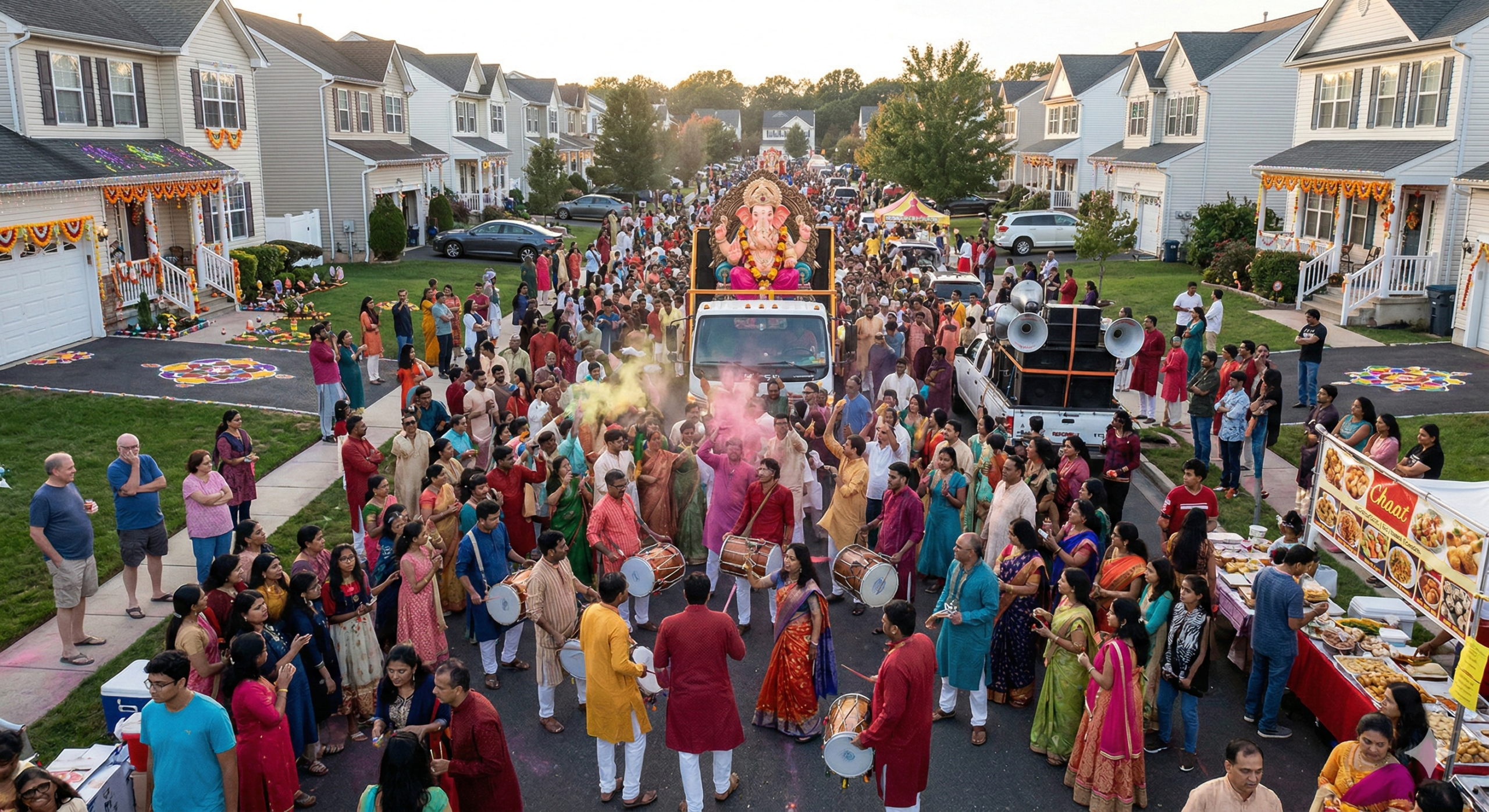
Moving beyond the digital sphere, the physical transposition of diasporic religious practices into the American environmental landscape has become one of the most severe points of local friction. The Hindu festival of Ganesh Chaturthi culminates in the Visarjan—the ritual immersion of the elephant-headed deity’s idol into a body of water. Theologically, this symbolizes the impermanence of the mortal world and the god’s return to his celestial dwelling.33 While this practice possesses profound spiritual significance, its mass execution in the modern, industrialized era poses severe, scientifically documented environmental hazards.
Historically, Ganesh idols were crafted from natural, biodegradable clays sourced from local riverbanks, which dissolved harmlessly. However, the commercialization of the festival has led to the mass production of idols utilizing Plaster of Paris (PoP), cement, and synthetic plastics.33 PoP contains calcium sulfate hemihydrate, a chemical compound that requires months, and sometimes years, to fully dissolve. As it breaks down, it drastically reduces dissolved oxygen levels in the water, asphyxiating fish and devastating fragile aquatic ecosystems.34 Furthermore, these modern idols are adorned with highly toxic, heavy-metal-laden paints containing lead, mercury, cadmium, arsenic, and chromium, which are highly carcinogenic and permanently contaminate water tables.35
In India, the environmental devastation caused by this practice has prompted severe legal interventions. The Karnataka State Pollution Control Board (KSPCB) and the Central Pollution Control Board (CPCB) have repeatedly issued strict guidelines and outright bans on the manufacture and immersion of PoP idols, urging the use of eco-friendly alternatives and artificial immersion tanks, though enforcement in the subcontinent remains highly inconsistent due to political pressures.33
However, when this practice is imported to the United States and executed without adaptation to stringent Western environmental standards, it generates immediate and intense community backlash. In areas with high concentrations of Indian Americans, such as New Jersey, California, and New York, local environmentalists and native residents have documented the abandonment of toxic PoP idols and associated ritual debris—including synthetic saris, plastic flags, bamboo sticks, and coconut shells—in critical waterways.37
In New York, for example, the fragile estuarine ecosystem of Jamaica Bay has become a focal point of contention. Indo-American residents of Queens frequently use the bay as a stand-in for the sacred Ganges River to perform Visarjan.38 While viewed by the diaspora as an age-old act of devotion, local conservationists view it as an act of egregious pollution in an area where salt marshes are already shrinking and the shellfishing industry has been banned due to health concerns.38 Similarly, in New Jersey, the Lower Raritan Watershed Partnership has documented dozens of abandoned, non-biodegradable idols littering the riverbanks, directly counteracting millions of dollars in state-funded ecological restoration efforts.37
For local municipalities and environmental commissions working aggressively to implement plastic reduction ordinances and restore waterways, the deliberate introduction of heavy metals and non-biodegradable waste under the guise of religious freedom is viewed as an absolute violation of civic responsibility.39 The refusal of certain segments of the diaspora to adapt their religious expression to the environmental realities and laws of their host nation acts as a powerful accelerant for anti-immigrant sentiment. To the native observer, a community that demands economic inclusion and “taxpayer” respect while simultaneously poisoning local drinking water systems demonstrates a profound lack of respect for the land they inhabit. As noted in local community forums, while the expression of religious practice is protected in Western democracies, it is strictly expected to remain within the moral, legal, and ecological parameters of the local land; failure to do so validates accusations of an arrogant refusal to integrate.40
The Diwali Divide: Noise Pollution, Safety Hazards, and Suburban Chaos
The most acute, highly visible, and sensory intersection of cultural preservation and civic disruption occurs during the observance of Diwali, the Hindu festival of lights. Traditionally celebrated in the high-density, high-tolerance acoustic environments of the Indian subcontinent, the wholesale transplantation of massive, unregulated fireworks displays into the low-density, highly regulated suburban landscapes of North America has triggered widespread, furious residential friction.41
The environmental and physiological impacts of mass firecracker detonations are well-documented globally. The explosion of fireworks releases massive concentrations of fine particulate matter (PM2.5)—toxic particles smaller than a human hair that deeply penetrate lung tissue.42 During Diwali celebrations, local Air Quality Indexes (AQI) experience immediate, dangerous spikes. These particulates, combined with toxic chemicals used for coloration, trigger severe inflammatory responses, elevate blood pressure, and cause acute respiratory distress, particularly in vulnerable populations such as the elderly and asthmatic.44 Furthermore, the impulse noise generated by consumer firecrackers regularly exceeds 120 to 125 decibels—well beyond the World Health Organization’s threshold for auditory damage—causing severe distress to domestic pets, local wildlife, and individuals suffering from stress disorders or PTSD.44
In the United States and Canada, the strict insistence on executing these explosive traditions has led to severe property damage, municipal chaos, and viral confrontations. In late 2024 and 2025, multiple incidents inflamed local tensions to a breaking point. In Edmonton, Canada, and Queens, New York, errant Diwali fireworks resulted in severe residential structure fires. Homes were completely gutted, families were displaced into hotels, and local police were forced to issue arson charges against the perpetrators.47 In Morrisville, North Carolina, illegal fireworks were set off inside a public park, causing significant damage to a cricket field, leaving behind massive amounts of toxic litter, and severely disrupting community sports programs, prompting an angry public rebuke from the local police department.49
The situation in New Jersey provides a quintessential case study of this civic collision. In heavily Indian-populated cities like Jersey City and Edison, local police and fire departments were completely overwhelmed by emergency calls.47 Viral footage documented chaotic scenes where municipal fire brigades were forced to deploy water hoses to clear streets heavily blanketed in smoldering firecracker debris, while defiant crowds of revelers cheered.41 While some participants quickly utilized social media to defend their actions—claiming they possessed municipal permits and that the fire brigade was merely managing a localized safety issue regarding unauthorized “skyshots”—the visual optics of the event were disastrous for the community’s public relations.41
The digital footprint of these events reveals a deeply fractured civic environment. Native residents utilizing community boards and neighborhood applications expressed profound frustration over multi-day, late-night detonations that sounded like “grenades and high-powered rifles,” completely disregarding local noise ordinances and curfews.52 The defense mounted by some diaspora members highlights a stark deficit in civic empathy. When questioned about the disruption, some youths reportedly argued that if the fireworks are sold legally in the U.S., they should not be blamed for using them, while others attempted to deflect criticism by pointing to America’s systemic issues with gun culture—stating, “Let the U.S. stop its gun culture first, that’s more dangerous than Diwali crackers”.52
| Diwali Civic Disruption Impacts | Documented Consequences & Incidents |
| Acoustic & Health Hazards | Noise levels exceeding 125 dB; spikes in PM2.5 causing respiratory distress.44 |
| Property Damage | Severe residential structure fires reported in Edmonton (Canada) and Queens (NY).48 |
| Municipal Strain | Edison, NJ reported 40+ emergency calls; Jersey City required fire brigade intervention to clear streets.47 |
| Public Infrastructure Damage | Illegal fireworks heavily damaged a public park/cricket field in Morrisville, NC.49 |
This friction is the absolute crux of the assimilation debate. Ignoring local curfews, traumatizing domestic animals, polluting the breathable air, burning down residential structures, and dismissing the basic sleep and safety requirements of neighbors are interpreted by the host population as a fundamental lack of basic civic morality. It signals an insular prioritization of in-group cultural performance over the collective well-being of the shared community. When the diaspora fails to recognize that suburban American life is fundamentally predicated on strict adherence to zoning, noise, and environmental ordinances, they inadvertently validate the xenophobic narrative that they are an invasive, inconsiderate presence incapable of adapting to Western civic standards.
Synthesis: Policy, Perception, and the Imperative of Adaptation
The surging anti-Indian sentiment in the United States cannot be attributed to a single variable; rather, it is the volatile result of a complex confluence of macroeconomic pressures, rapid demographic realities, and unforced, highly visible cultural errors by the diaspora itself.
From a macro-structural perspective, the massive scale of the migration and the community’s rapid dominance in high-wage tech and medical sectors invariably triggers economic anxiety among the native working and middle classes. The contemporary political environment actively harnesses this economic insecurity, framing the demographic shift as a zero-sum threat to native heritage and labor.1
However, sociological reality dictates that systemic prejudice requires a narrative scaffolding—a foundation of observable, negative behavior—to take root and flourish in the broader public consciousness. The Indian diaspora inadvertently constructs and fortifies this scaffolding when segments of the community engage in highly visible, socially disruptive behaviors. The staggering arrogance perceived in the “we built this/we pay taxes” viral content, the psychological cruelty of influencers engaging in local body-shaming, the environmental blindness of immersing toxic heavy-metal idols into protected waterways, and the blatant civic disregard demonstrated during late-night Diwali detonations collectively serve as undeniable, empirical ammunition for nativist arguments.
These actions violate the unwritten social contract of migration. While the host nation is legally and morally bound to provide equal opportunity, physical safety, and protection under the law, the immigrant community is sociologically expected to adapt to the civic, environmental, and behavioral norms of their new environment. When a highly successful diaspora utilizes its massive economic leverage as a shield to deflect valid criticisms of civic disruption, it shatters the myth of the “model minority.” In its place, it constructs the specter of the permanent, unassimilable outsider who views the host nation merely as an economic hotel rather than a shared home.
The sentiment expressed by frustrated locals—that immigrants unwilling to assimilate should return to their countries of origin—is not merely an expression of blind racism; in many instances, it is a desperate reaction to a perceived loss of local order, environmental sanctity, and civic peace.
Conclusion
The rising tide of hostility directed toward the Indian American community is a multi-dimensional sociological phenomenon. It is undeniably fueled, in part, by systemic xenophobia, political opportunism, and economic anxieties that are entirely divorced from the actual behavior of the immigrants themselves. However, objective sociological analysis necessitates acknowledging that cultural friction is inherently bidirectional.
The diaspora’s unparalleled economic success, high educational attainment, and massive tax contributions do not grant immunity from the sociological imperatives of assimilation. For integration to succeed without triggering severe, potentially dangerous nativist backlash, the immigrant community must navigate the liminal space between cultural preservation and civic adaptation with significantly greater acute awareness.
Celebrating ethnic heritage is a fundamental cornerstone of American multiculturalism; however, when those celebrations manifest as severe environmental degradation through toxic idol immersion, or as civic disruption through unregulated, explosive noise pollution, they cease to be protected cultural expressions. They become matters of public nuisance and public safety. Furthermore, digital posturing that mocks the physical vulnerabilities of the host population, or arrogantly equates civic belonging solely with tax bracket contributions, only serves to alienate potential allies and validate the worst stereotypes propagated by extremist hate groups.
Ultimately, the mitigation of anti-Indian sentiment requires a dual approach. It requires the host nation to actively reject the algorithmic amplification of racist tropes and recognize the profound fiscal and innovative contributions of the diaspora. Simultaneously, and perhaps more urgently, it demands that the Indian American community embrace a more nuanced, humble understanding of integration—one that recognizes that true assimilation is measured not merely by economic output, but by a demonstrated respect for the environmental, civic, and social fabric of the land they now inhabit. Failure to internalize this reality will only ensure the continued escalation of cultural friction and the further erosion of the community’s standing in their adopted homeland.
Works cited
- Will anti-Indianism spread across the Anglosphere? – Global Order, accessed on February 27, 2026, https://www.globalorder.live/post/will-anti-indianism-spread-across-the-anglosphere
- From Model Minority To Visible Target – Khabar, accessed on February 27, 2026, https://khabar.com/coverstory/from-model-minority-to-visible-target/
- Indian Immigrants Boost U.S. Economy Despite Political Backlash, accessed on February 27, 2026, https://xiphiasimmigration.com/news/indian-immigrants-us-economy-2025-report
- What the data says about immigrants in the U.S. – Pew Research Center, accessed on February 27, 2026, https://www.pewresearch.org/short-reads/2025/08/21/key-findings-about-us-immigrants/
- United States: International Migration Outlook 2025 | OECD, accessed on February 27, 2026, https://www.oecd.org/en/publications/2025/11/international-migration-outlook-2025_355ae9fd/full-report/united-states_1d634ce3.html
- Indian Americans – Wikipedia, accessed on February 27, 2026, https://en.wikipedia.org/wiki/Indian_Americans
- Indians | Data on Asian Americans – Pew Research Center, accessed on February 27, 2026, https://www.pewresearch.org/race-and-ethnicity/fact-sheet/asian-americans-indians-in-the-u-s/
- New York adds just 1,008 people in 2024–25 as immigration plummets to lowest level in four years, accessed on February 27, 2026, https://timesofindia.indiatimes.com/world/us/new-york-adds-just-1008-people-in-202425-as-immigration-plummets-to-lowest-level-in-four-years/articleshow/128751522.cms
- Immigration fuels Indiana’s strong population growth in 2024 — its largest annual increase since 2008 – News at IU, accessed on February 27, 2026, https://news.iu.edu/live/news/44768-immigration-fuels-indianas-strong-population-growth-in
- New Population Estimates Show Decline in Net International Migration – Census Bureau, accessed on February 27, 2026, https://www.census.gov/newsroom/blogs/random-samplings/2026/01/historic-decline-in-net-international-migration.html
- Hate Messages Against Indian Immigrants Surge on US Social Media – AAPI Equity Alliance, accessed on February 27, 2026, https://aapiequityalliance.org/hate-messages-against-indian-immigrants-surge-on-us-social-media/
- Indian Americans in a Time of Turbulence: 2026 Survey Results, accessed on February 27, 2026, https://carnegieendowment.org/research/2026/02/indian-americans-in-a-time-of-turbulence-2026-survey-results
- Indians in the US: a thriving and growing community – Working Immigrants, accessed on February 27, 2026, https://www.workingimmigrants.com/2025/01/indians-in-the-us-a-thriving-and-growing-community/
- ‘Indian takeover of Frisco’: NRI handle reacts to Texas viral video; ‘That’s not a threat, that’s diversity’ – The Times of India, accessed on February 27, 2026, https://timesofindia.indiatimes.com/world/us/indian-takeover-of-frisco-nri-handle-reacts-to-texas-viral-video-thats-not-a-threat-thats-diversity/articleshow/123170520.cms
- The Rhetoric of White Supremacist Terror: Assessing the Attribution of Threat – Syracuse University, accessed on February 27, 2026, https://securitypolicylaw.syr.edu/wp-content/uploads/2018/07/Blessing_Roberts_Berlin_Report-mwedit070618.pdf
- POPULIST – People’s Action, accessed on February 27, 2026, https://peoplesaction.org/wp-content/uploads/PA_Report_Final_digital.pdf
- Copyright 2021. Princeton University Press. All rights reserved. May not be reproduced in any form without permission from the, accessed on February 27, 2026, https://www.asau.ru/files/pdf/2803363.pdf
- Christian Theology in the Age of Migration: Implications for World Christianity 2019955248, 9781793600738, 9781793600745 – DOKUMEN.PUB, accessed on February 27, 2026, https://dokumen.pub/christian-theology-in-the-age-of-migration-implications-for-world-christianity-2019955248-9781793600738-9781793600745.html
- Cultural Assimilation vs. Cultural Preservation: The Migrant Dilemma, accessed on February 27, 2026, https://www.icmc.net/2025/11/26/cultural-assimilation-vs-cultural-preservation/
- Assimilation Models, Old and New: Explaining a Long-Term Process, accessed on February 27, 2026, https://www.migrationpolicy.org/article/assimilation-models-old-and-new-explaining-long-term-process
- A Study of Association, Assimilation and Adaptation Among Second-Generation Indian American Youth, accessed on February 27, 2026, https://ijssrr.com/journal/article/download/2939/2040/
- Taxes, taxpayers, and settler colonialism: Toward a critical fiscal sociology of tax as white property | Law & Society Review | Cambridge Core, accessed on February 27, 2026, https://www.cambridge.org/core/product/A64C397E269523DDA5846F28160AC3FD/core-reader
- Indian immigrants most economically beneficial to US: Report – The American Bazaar, accessed on February 27, 2026, https://americanbazaaronline.com/2025/10/29/indian-immigrants-most-economically-beneficial-to-us-report-469331/
- DEFENCE STRATEGIC COMMUNICATIONS – StratCom, accessed on February 27, 2026, https://stratcomcoe.org/publications/download/DSC_NATO_journal_V11_FIN-53f86.pdf
- U.S. Man Accuses Indian Mean Of Being Out Of Shape| Indians In U.S. – YouTube, accessed on February 27, 2026, https://www.youtube.com/watch?v=AWizeCMg57g
- Fat shaming is making people sicker and heavier – PMC, accessed on February 27, 2026, https://pmc.ncbi.nlm.nih.gov/articles/PMC6565398/
- Jain: Weight stigma and body-shaming needs to end – The Observer, accessed on February 27, 2026, https://observer.case.edu/jain-weight-stigma-and-body-shaming-needs-to-end/
- Anti-Indian Racism on X (July–September 2025), accessed on February 27, 2026, https://www.csohate.org/2025/09/16/anti-indian-racism-on-x-july-september-2025/
- Why South Asian Hate Feels Different This Time – The Juggernaut, accessed on February 27, 2026, https://www.thejuggernaut.com/south-asian-hate-racism-rise-in-online-hate-america-canada
- ‘Go Back to Your Country’: The Surge of Anti-Indian Sentiment on American Social Media, accessed on February 27, 2026, https://aapiequityalliance.org/go-back-to-your-country-the-surge-of-anti-indian-sentiment-on-american-social-media/
- US Influencer Calls Indians Scammers | Firstpost America | N18G – YouTube, accessed on February 27, 2026, https://www.youtube.com/shorts/-tjrhGAGKN8
- ‘They are not Americans’: Right-wing influencer accuses Indian-Americans of housing ‘scam’ in Texas cities – The Times of India, accessed on February 27, 2026, https://timesofindia.indiatimes.com/world/us/they-are-not-americans-right-wing-influencer-accuses-indian-americans-of-housing-scam-in-texas-cities/articleshow/128535492.cms
- Immersed In Legal Waters – P U N A R A V A R T A N, accessed on February 27, 2026, https://punaravartan.org/immersed-in-legal-waters/
- What Really Is The Environmental Impact Of Ganesh Chaturthi? – Travel.Earth, accessed on February 27, 2026, https://travel.earth/environmental-impact-of-ganesh-chaturthi/
- Ganesh Visarjan’s Dark Side: Water Pollution & Toxic Colors | Environmental Concerns After Festivals – YouTube, accessed on February 27, 2026, https://www.youtube.com/watch?v=y_ce9_H5x1M
- Ganesh Chaturthi 2025 | Karnataka High Court Bans Plaster Of Paris Idols Over Environmental Concerns – LawChakra, accessed on February 27, 2026, https://lawchakra.in/high-court/ganesh-chaturthi-alert/
- Month: September 2018 – Lower Raritan Watershed Partnership, accessed on February 27, 2026, https://lowerraritanwatershed.org/2018/09/
- In New York City’s Waters: Holiness or Pollution? – New Lines Magazine, accessed on February 27, 2026, https://newlinesmag.com/reportage/in-new-york-citys-waters-holiness-or-pollution/
- ANJEC Report, accessed on February 27, 2026, https://anjec.org/wp-content/uploads/2022/04/ANJEC_Report_Spring-2022-1.pdf
- I saw people doing Ganpati Visarjan near the river by Abbey Park at the weekend. Can someone help me understand why it was OK to leave it in the water please? : r/leicester – Reddit, accessed on February 27, 2026, https://www.reddit.com/r/leicester/comments/1nbtbfa/i_saw_people_doing_ganpati_visarjan_near_the/
- Diwali Fireworks Spark Debate: Celebrations Meet Legal Limits and Community Tensions Across U.S. Cities – American Kahani, accessed on February 27, 2026, https://americankahani.com/lead-stories/diwali-fireworks-spark-debate-celebrations-meet-legal-limits-and-community-tensions-across-u-s-cities/
- Is celebration of New Year and other festivals worth their environmental impact?, accessed on February 27, 2026, https://www.researchgate.net/publication/380375272_Is_celebration_of_New_Year_and_other_festivals_worth_their_environmental_impact
- Message from the Chair, December 2025: Fireworks are Breathtaking – Maricopa Association of Governments, accessed on February 27, 2026, https://azmag.gov/Newsroom/MAG-News/quarter-2-message-from-the-chair-fireworks-are-breathtaking
- After the Festivities: Understanding the Health Impact of Post-Diwali Air and Noise Pollution, accessed on February 27, 2026, https://blallab.com/blogs/understanding-the-health-impact-of-post-diwali-air-and-noise-pollution
- A Systematic Review of Fireworks Noise and Its Exceedance of WHO Outdoor Limits: Global Trends and Implications | Request PDF – ResearchGate, accessed on February 27, 2026, https://www.researchgate.net/publication/378569184_A_Systematic_Review_of_Fireworks_Noise_and_Its_Exceedance_of_WHO_Outdoor_Limits_Global_Trends_and_Implications
- Fireworks safety survey – eScribe, accessed on February 27, 2026, https://pub-wilmot.escribemeetings.com/filestream.ashx?DocumentId=12310
- Diwali Celebrations by Indians End In Damage to Property In US – Gulte, accessed on February 27, 2026, https://www.gulte.com/overseas/378519/diwali-celebrations-by-indians-end-in-damage-to-property-in-us
- Fire accidents, social media outrage: Indians turn Diwali celebrations in the US and Canada bitter – The South First, accessed on February 27, 2026, https://thesouthfirst.com/news/fire-accidents-social-media-outrage-indians-turn-diwali-celebrations-in-the-us-and-canada-bitter/
- Diwali fireworks prompt police warnings and safety concerns in many US cities, accessed on February 27, 2026, https://americanbazaaronline.com/2025/10/22/diwali-fireworks-prompt-safety-concerns-us-469042/
- Indian man in US clarifies after Diwali fireworks draw fire brigade, trolling – India Today, accessed on February 27, 2026, https://www.indiatoday.in/trending-news/story/indian-man-in-us-clarifies-after-diwali-fireworks-draw-fire-brigade-trolling-viral-video-2807103-2025-10-23
- Watch: Why fire brigade had to step in during US Diwali fireworks – The Times of India, accessed on February 27, 2026, https://timesofindia.indiatimes.com/etimes/trending/watch-why-fire-brigade-had-to-step-in-during-us-diwali-fireworks/articleshow/124760153.cms
- USA: Frustration Flares Amid Diwali Fireworks – GreatAndhra, accessed on February 27, 2026, https://www.greatandhra.com/articles/special-articles/usa-frustration-flares-amid-diwali-fireworks-150197
- Diwali Fireworks. I take back my post yesterday thanking revelers for being respectful. Last night they blew off fireworks until 3AM. By far, the most disrespectful thing I’ve ever witnessed / endured in our neighbourhood : r/waterloo – Reddit, accessed on February 27, 2026, https://www.reddit.com/r/waterloo/comments/yd1trq/diwali_fireworks_i_take_back_my_post_yesterday/
- Project 2025: How a Republican Plan Could Rock the Indian American Dream, accessed on February 27, 2026, https://stophindudvesha.org/project-2025-how-a-republican-plan-could-rock-the-indian-american-dream/