

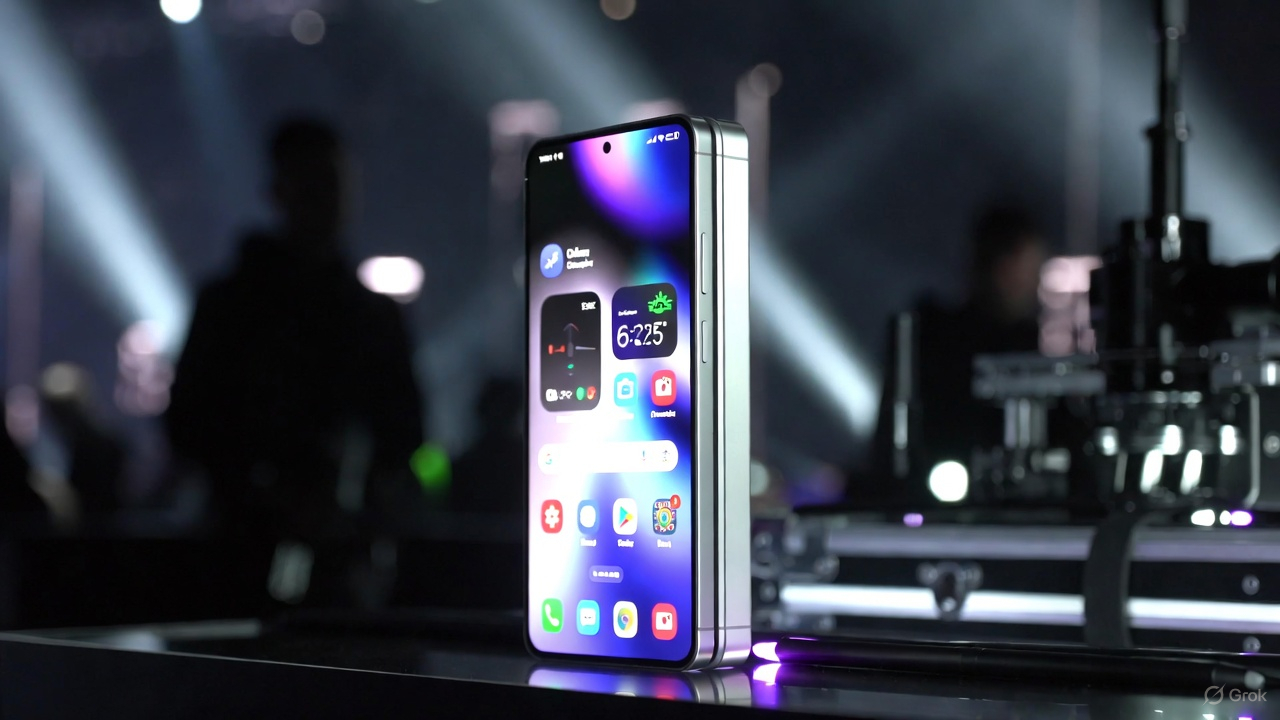
For years, the annual smartphone reveal has felt like a predictable exercise in incrementalism—a relentless, numerical race toward faster chips and larger sensors that often leaves users with “spec fatigue.” We have reached a point of diminishing returns where the mental friction of managing our devices outweighs the excitement of owning them. However, the debut of the Galaxy S26 series suggests a fundamental pivot in the industry’s trajectory. As Samsung unveils its “third generation of AI phones,” the narrative has shifted away from raw hardware muscle toward a device that finally “understands” the nuance of human life. This isn’t just another upgrade; it’s the moment the smartphone begins to feel less like a tool and more like an intuitive companion.
1. Built-In Stealth (The End of the Privacy Screen Protector)
One of the most immediate lifestyle upgrades, exclusive to the Galaxy S26 Ultra, is the Privacy Display. We’ve all experienced the digital vulnerability of a shoulder-to-shoulder commute where every private text or banking login feels like public property. Samsung has spent half a decade engineering a solution that renders third-party plastic filters obsolete. The technology allows the screen to remain crisp and vibrant for the user while effectively “blacking out” visibility from side angles, above, and below. Crucially, this isn’t a permanent tint; users can toggle the protection via a double-press of the side button or set it to activate selectively when entering a PIN or viewing notification pop-ups.
“Privacy Display is the result of more than five years of research and development, blocking views from the sides, above and below.”
This innovation marks a significant step toward reclaiming personal space in an increasingly crowded world. By integrating privacy into the hardware layer and making it contextually switchable, Samsung is addressing the social anxiety of “over-the-shoulder” snooping. It reflects a sophisticated understanding of the modern user’s environment—elevating the device from a mere display of information to a guardian of one’s digital boundaries in elevators, trains, and coffee shops.
2. The “Now Nudge” and the Death of App-Switching
The modern mobile experience is often defined by “app fatigue”—that frantic thumb-swiping and mental tax required to jump between a group chat and a calendar to confirm a dinner date. The S26 introduces “Now Nudge” to obviate this cognitive overhead. Instead of forcing you to hunt for information, the phone’s contextual AI monitors the flow of your conversation. If a friend suggests a time that conflicts with your schedule, a tailored “Nudge” pop-up appears with context-aware icons, surfacing your availability directly within the messaging interface.
This marks a shift from a reactive device to a proactive assistant, effectively breaking down the silos between applications. By streamlining these micro-tasks, Samsung is reducing the friction of daily logistics. The analysis here is clear: the era of the “app-centric” phone is fading, replaced by a “task-centric” model where the device follows the user’s intent rather than forcing the user to navigate the phone’s architecture.
3. Speaking “Human” Instead of “Settings”
For the average user, the deep-seated menus of a modern smartphone are a labyrinth of frustration. The Galaxy S26 series attempts to make the interface “invisible” by integrating Bixby, Gemini, and Perplexity into a unified agent system. Rather than hunting for the “Eye Comfort Shield” under Display Settings, a user can simply state, “My eyes feel tired.” The device interprets the intent behind the sentiment and suggests the appropriate adjustment immediately. This collaboration of AI agents allows the phone to translate vague human needs into specific technical executions without the user needing to speak “marketing-speak” or “tech-manual.”
This democratization of technology is perhaps the most human-centric takeaway of the launch. It removes the barrier to entry for those who aren’t “tech-savvy,” ensuring that advanced features are accessible to anyone who can hold a conversation. By moving toward a natural language interface, Samsung is acknowledging that the most powerful technology is the kind you don’t have to think about using.
4. The AI “Time Machine” in Your Camera
While the Ultra’s 200MP wide-angle lens and its 50MP 5x optical zoom are impressive on paper, the true innovation lies in the “Creative Studio” and “Photo Assist” suites. These tools move beyond simple filters, allowing users to “restore” reality—such as using AI to seamlessly reconstruct a birthday cake with a bite taken out of it. The “Creative Studio” further pushes into generative territory; users can type a simple text prompt like “Please draw me a dog” to instantly create custom sticker sets for invitations or messages, or even transform a daytime shot into a nightscape with a wardrobe change to match.
“The Galaxy S26 Ultra features a 200-megapixel (MP) wide-angle camera and a 50 MP telephoto camera with 5x optical zoom and 10x optical-quality zoom.”
This represents a philosophical shift in mobile photography: we are moving from “capturing reality” to “capturing intent.” In this new paradigm, the AI fills the gaps between the imperfect moment we caught and the perfect memory we intended to preserve. Whether it is removing an unwanted object or generating a context-based sticker, the phone is no longer just a recorder; it is a creative collaborator that understands what the user wanted the image to be.
5. Slimmer Profile, Smarter Front-End
In a market where “Ultra” has often become synonymous with “bulky,” the S26 Ultra is a welcome rejection of that stereotype. By shaving 0.3mm off the thickness and bringing the weight down to 214g, Samsung has focused on ergonomic elegance. This physical refinement is matched by a major shift in processing: the AI ISP (Image Signal Processor) has finally been extended to the front-facing camera. This allows for a level of “natural” aesthetic previously reserved for rear-camera portraits, capturing intricate details down to individual hair strands and eyebrows while maintaining authentic skin tones.
The takeaway here is that Samsung is prioritizing the human feel and appearance over raw, bulky hardware. By applying high-end processing to the front-facing camera, they are acknowledging that the way we represent ourselves in a selfie is just as vital as a 10x zoom shot of a distant landmark. It is a more balanced approach to design—one that values the comfort of the hand and the realism of the face as much as the power of the processor.
Conclusion: Beyond Intent Recognition
The Galaxy S26 series signals the end of the “Specs War” and the beginning of the “Identity War.” As we move beyond simple intent recognition, the device begins to offer a personalized experience that feels less like a piece of glass and silicon and more like a seamless extension of our own habits and preferences.
This evolution brings us to a provocative crossroad: When our phones begin to anticipate our needs before we even express them, does the device become an extension of our personality rather than just a tool? If the S26 is any indication, the future of the smartphone isn’t about how much it can do, but how well it knows who you are.